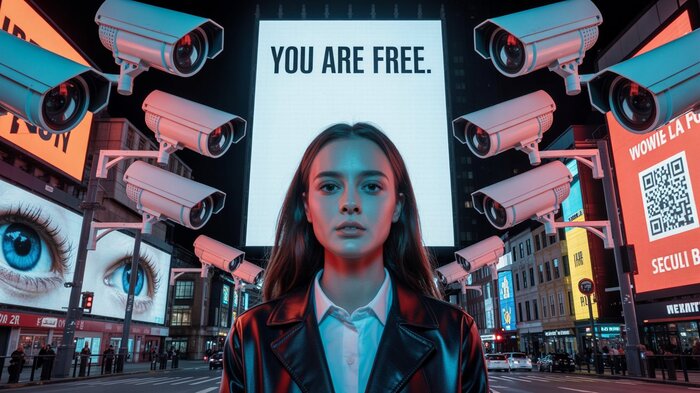
The Illusion of Freedom: How the West Is Becoming What It Claims to Oppose
For generations, people in the United States, the United Kingdom, and Europe have been told that they live in the “free world.”
They grow up believing that freedom of speech, freedom of choice, and freedom of thought are the values that separate the West from countries like China.
But when you look closer, the gap between the two worlds is closing fast. Western governments talk about liberty while quietly building systems that watch, guide, and punish citizens in ways that once seemed unthinkable.
The result is a strange new form of control that looks different on the surface but leads to the same destination.
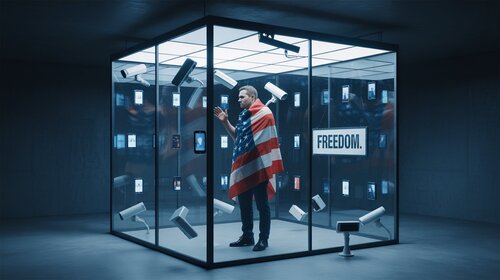
Freedom and the Illusion of Choice
In theory, people in the West can choose their leaders and speak their minds. In practice, many feel that nothing ever really changes. No matter which party wins, the same wars continue, the same surveillance expands, and the same powerful interests remain untouched.
Elections replace the faces but rarely the direction of travel. Voters sense that they are choosing between managers of one system rather than creators of new paths.
This feeling has created quiet frustration and the belief that “democracy” has become a performance rather than a promise.
The Rise of Technocratic Control
While Western governments still talk about liberty, they are building a new type of order that relies on technology rather than ideology.
Every phone, card, and camera feeds data into systems that can track habits, purchases, opinions, and movements. Social media companies cooperate with governments to remove or hide information that challenges official stories.
Financial institutions can freeze or close accounts for those who think or speak outside accepted boundaries.
These systems are presented as tools for safety, efficiency, or public health, yet they form the skeleton of a digital cage. It is the same logic used in China: control behavior first, explain it later as protection.

The Quiet Disappearance of Free Speech
In the United States, the First Amendment still exists, but censorship no longer needs to come through law. It comes through cooperation.
Governments now “flag” content for removal by private companies. They fund fact-checking centers and “disinformation” offices that guide what information is visible online.
In Europe and the U.K., laws like the Digital Services Act and the Online Safety Act pressure companies to delete “harmful” or “misleading” content or face huge fines.
At first this sounded reasonable. No one wants lies, hate, or violence to spread.
But the definitions of harm and misinformation have widened to include anything that challenges authority. Health debates, election questions, and criticism of foreign policy have all been limited in the name of safety.
Today, people do not always notice when information disappears. It is not burned or banned. It simply fades from the search results and stops appearing in their feeds.

Freedom Without Safety Is Not Freedom
There is another kind of fear spreading in the West. It is not fear of government but fear of crime. In many cities, people hesitate to walk at night or take public transport after dark. Shops close early, and small businesses are robbed again and again.
In countries that once prided themselves on order and civility, ordinary citizens now live with rising violence, drug use, and theft. Many ask a simple question: Are you truly free if you are afraid to walk the streets?
Large waves of unvetted migration have added to this tension. Communities struggle to cope as governments promise compassion yet fail to maintain security. People who speak about it risk being called intolerant, yet the problem is real.
When safety vanishes, freedom becomes a theory, not a reality.
In contrast, citizens in countries like China can often leave a laptop or phone unattended in a café and return to find it still there. They live under strict political control, but they walk through their cities without fear.
The irony is that many Westerners think of themselves as free while living with daily anxiety and disorder.
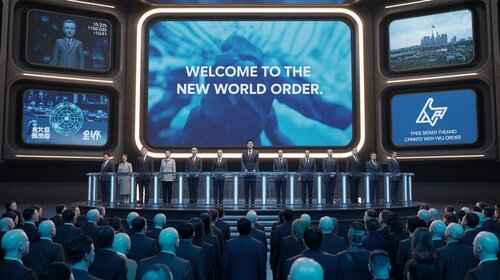
The New Face of State Power
China's system of control is clear and open. The Communist Party decides what is allowed, and citizens know the rules. The West's version is polite and hidden.
Instead of direct orders, it uses rules written by corporations. Instead of police censors, it uses algorithms. Instead of prison, it uses social exclusion, job loss, and digital invisibility.
This is why so many Westerners still believe they are free. They can criticize the government in small ways and vote every few years. They can speak, but their voices are often buried beneath a tide of managed content. The freedom remains in law but fades in life.
How People Trade Freedom for Comfort
These systems did not appear by force. They were invited in. People accepted them for convenience and safety. Smart devices make life easier. Surveillance promises security. Content moderation protects us from harm. Each new control seems harmless by itself. Together they build a world that can monitor every citizen, every transaction, and every thought.
The most powerful controls are not violent. They are invisible, built into habits and screens. They shape what we see, what we think, and even what we believe is real.

The Chinese Mirror
It is ironic that while Western leaders often criticize China for its authoritarian system, their own governments are constructing the same tools.
Facial recognition cameras, data monitoring, social media censorship, and digital currencies are all becoming normal in Western democracies. The only difference is the branding.
One system says it protects social harmony. The other says it protects democracy. Both lead to the same place: control through technology.
The Real Meaning of Freedom
Freedom is not only the right to vote or to speak. It is the ability to live without fear, to make choices without invisible limits, and to seek truth without permission.
When governments and corporations decide what we are allowed to see or say, freedom becomes a slogan, not a reality.
True freedom means being trusted to think for ourselves, even when our thoughts are unpopular. It means a society strong enough to face lies and mistakes without silencing voices. It means citizens who question authority, not citizens who quietly obey in exchange for comfort.
A Choice for the Future
The West stands at a crossroads. It can continue down the path of managed speech, rising crime, and digital surveillance, or it can remember what real liberty means.
China's system shows what the end of this road looks like. If Western nations do not protect genuine freedom now, they will arrive at the same place, only with a smile and a smartphone.
Freedom is not something governments give or take. It is something people defend by refusing to surrender their minds or their courage.
About the Author
Scott Oliver is a British writer and former Royal Marines Commando who has lived abroad since 1985. Over the last 66 years, he’s called twelve countries home, including twenty-five years in Spanish-speaking nations such as Spain, Costa Rica, and Guatemala. He has also lived in Sierra Leone, Ghana, Nigeria, Liberia, Cyprus, the USA, Grand Cayman and now lives in Mauritius.
A warrior by nature, Scott is living with prostate cancer and writing from the front lines. He speaks directly to men about health, masculinity, freedom, and strength, physically, mentally, emotionally, and sexually. His views are proudly independent: he questions conventional medicine, challenges destructive treatments, and tells the truth most men never hear.
Scott Oliver is an officially accredited member of the National Writers Union (NWU) and the International Federation of Journalists (IFJ), the world’s largest organization of professional journalists. He spent ten years on Wall Street and another decade as an offshore wealth manager, specializing in globally diversified, multi-currency hedge fund portfolios. He is the author of What If Cancer’s Best Defense Is Free? — Sleep as a Defense Against Cancer: A Former Royal Marines Commando’s 4,000-Hour Research Roadmap, where he reveals how sleep repairs DNA, restores immunity, and strengthens your fight against cancer. He’s also the author of books on offshore investing and Costa Rica real estate and has written thousands of articles in English and Spanish on living abroad with courage, clarity, and conviction.
You can always contact Scott Oliver here with your questions and suggestions.