From Vietnam to the U.S.: The Digital Prison Is Closer Than You Imagine
If you want to see the future of digital identity, look no further than Vietnam. In the summer of 2025, the country deleted over 86 million bank accounts that weren't tied to a new biometric ID system.
Imagine waking up, checking your banking app, and finding that your money had simply vanished. No warning. No appeal. Just gone. For millions of Vietnamese, this wasn't a nightmare, it was reality.
The system behind it is called VNeID. It links everything: your banking, your taxes, your medical history, your housing, even your travel records. Without it, foreigners and locals alike cannot open accounts, rent apartments, or sometimes even renew visas.
One American living in Hanoi discovered this the hard way when his visa renewal stalled simply because he hadn't enrolled in the new ID system. The message is clear: no ID, no access.
It's not just Vietnam. Thailand has already begun requiring biometrics for foreigners applying for work permits and visas. India has its Aadhaar system, a massive database of fingerprints and iris scans tied to almost every aspect of daily life, from receiving welfare to getting a SIM card.
Spain gave us a different lesson when a massive blackout turned tens of millions of lives upside down. With power gone, phones, ATMs, and payment systems all failed. For hours, modern life simply stopped.
The lesson is obvious. If you build a system where everything depends on a digital ID and a cashless economy, one disruption can lock you out of life itself.
So What About The United States?
Right now, America doesn't have a single national digital ID like Vietnam. Instead, it has the pieces.
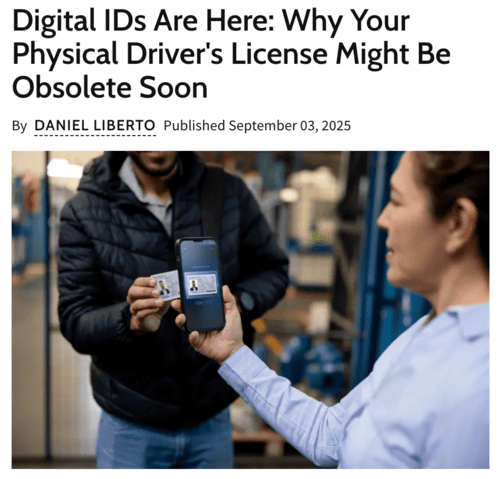
Many states already offer mobile driver's licenses stored in your phone. TSA is running trials that let you board planes with a digital ID. Banks verify identities through Know Your Customer rules.
Palantir's software stitches together vast datasets for defense, health, and law enforcement. In other words, the building blocks exist. They're just not tied together—yet.
The real question is what happens in a crisis. History shows that emergencies change the rules. After 9/11, Congress passed the Patriot Act almost overnight, giving sweeping new surveillance powers.
During COVID-19, vaccine passports were piloted in many countries, and Palantir's system, HHS Protect, became the federal hub for pandemic data. If there's a new pandemic, a major cyberattack, or a war, these tools could be fused in a matter of months.
A likely timeline would look like this.
- First, an emergency is declared. Federal agencies dust off data hubs like HHS Protect and start linking hospital, banking, and travel records.
- Then TSA expands digital ID use at airports and the government promotes digital health passes to move around freely.
- Banks tighten verification rules, connecting access to official IDs.
- Next comes money. If tens, even hundreds of millions of people lose jobs in an economic crash, a universal basic income could be rolled out.
- To receive payments, you would need a verified digital ID. That requirement alone would push reluctant citizens into the system.
- Finally, once people are used to showing their phones for money, health, or travel, it becomes the norm. What started as temporary “emergency measures” hardens into everyday life.
This is where the idea of “never let a crisis go to waste” comes in. A crisis becomes the excuse to roll out systems that would never pass in ordinary times. People trade freedom for security. And once the system is live, it's almost impossible to reverse.
To be fair, there are benefits. Fraud drops. Bureaucracy shrinks. Companies like Samsung find it easier to invest when paperwork is fast. Small businesses can get loans quickly.
But there's a darker side too. Privacy erodes. Rural Americans without smartphones risk being left behind. And power concentrates in the hands of a few who control the databases. One policy change or one glitch could lock you out of your bank account, your job, or even your ability to travel.
To make this concrete, think of two simple lists.
Potential benefits:
• Faster services and fewer scams
• Easier banking and business approvals
Potential risks:
• Privacy invasion and tracking of daily life
• Lockouts during blackouts or technical failures
• Dependency on government-issued credentials for basic survival
That's the crossroads. Vietnam has already chosen the path of control. The U.S. hasn't yet but the pieces are there. And in an emergency, those pieces could be snapped together in weeks, not years.
The Prostate Cancer Warrior's Conclusion:
America is not Vietnam today. But the infrastructure exists, and in a crisis it could be activated at lightning speed.
The real safeguard isn't technology, it's the willingness of citizens to ask tough questions, demand legal limits, and refuse to sleepwalk into a future where freedom is traded for convenience.
The test is not whether digital IDs can be built, they already can. The test is whether Americans will resist turning crisis into control.

About the Author
Scott Oliver, 66, is living well with prostate cancer after dedicating more than 4,000 hours to researching the condition. His first goal is to help men reduce their risk of developing prostate cancer through proven lifestyle strategies.
When diagnosed, his mission is to help men avoid unnecessary prostate surgeries that can lead to devastating complications such as incontinence, bleeding, permanent impotence, and a loss of length.
Scott Oliver is not a doctor and does not offer medical advice; however, he is healthier and fitter than he has been in decades. Through his articles and videos, he shares hard-to-find, uncensored information on proven alternative therapies, effective fitness methods, and repurposed drugs, content that most doctors won’t mention and search engines suppress.
He is an accredited member of the National Writers Union (NWU) and the International Federation of Journalists (IFJ), the world’s largest organization of professional journalists. Scott is also the author of What If Cancer’s Best Defense Is Free? Sleep as a Defense Against Cancer: A Former Royal Marines Commando’s 4,000-Hour Research Roadmap, where he reveals how sleep repairs DNA, restores immunity, and strengthens the body’s natural defenses against cancer.
You can always contact Scott Oliver here with your questions and suggestions.
Expert Resources Used By Scott Oliver To Research and Write This Article:
Relevant Expert Resources
- Vietnam Extends Digital ID to Foreign Nationals in July 2025
- Digital ID Adoption Gathers Steam in Vietnam and Papua New Guinea
- Lessons from National Digital ID Systems for Privacy, Security, and Trust
- Digital IDs Are Here: What They Mean for You
- Digital IDs Take Root in the U.S. as States and Federal Agencies Chart Paths
- The Path to Digital Identity in the United States (ITIF)
- Logging In and Providing Proof: U.S. Government Digital Identity Guide
- TSA Rules on Biometrics and Digital IDs at Airports
- HHS Protect: The Pandemic Data Hub (Palantir Contract Overview)
- U.S. Federal Reserve – Central Bank Digital Currency (CBDC) Research