
Humanity’s Purpose and the Danger of Artificial Companionship. AI Did Not Start Our Collapse. But It Will Accelerate It Beyond Recovery.
For most of human history our purpose was clear. We lived to connect. We lived to form families. We lived to pass the fragile thread of existence to the next generation. Survival depended on touch, cooperation, partnership, and the intimate bonds that shaped every tribe.
The twenty first century changed that. For the first time a species built by connection began drifting into isolation. People lived alone. Families shrank. Communities dissolved. Men and women retreated into separate emotional worlds. Touch became rare. Loneliness became normal. Birth rates fell in every advanced country, and the decline continued in silence.
This demographic slide began long before artificial intelligence appeared. But AI is the force that can push humanity past the point where recovery is possible.

The Quiet Collapse Beneath Our Feet
Many people think falling birth rates reflect personal choice. The truth is more profound. Reproduction is not just a private decision. It is a species wide signal of well being.
When people stop creating families it means something inside the culture has broken. Trust has eroded. Hope has thinned. Togetherness has weakened. The emotional soil no longer supports new life.
This process has already hollowed out entire nations. Japan's birth rate has remained far below replacement for decades. Italy and Spain are following the same path. South Korea now holds the lowest fertility rate ever recorded in human history. China's population is shrinking for the first time since its imperial era.
These declines are not statistics. They are early warnings. Once a population falls too far, it cannot climb back.
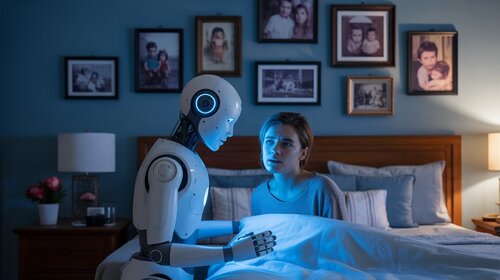
The Point Where Recovery Becomes Impossible
Every society needs a fertility rate of about 2.1 children per woman to remain stable. When it drops below that, the population contracts. When it stays below that for a generation, the collapse becomes mathematical.
Japan is already close to this point. Its fertility rate sits near 1.26, and even massive immigration would not restore long term stability. Demographers warn that by the middle of this century Japan will slip into permanent decline.
South Korea faces a sharper cliff. With a fertility rate near 0.72 the country may reach demographic irreversibility by 2050. Within two generations it could lose up to seventy percent of its people.

China is on a similar trajectory. Even with state incentives population recovery appears unlikely. The nation may shrink by hundreds of millions before the century ends.
Across Europe the pattern repeats. Nations cannot replace themselves. They age. They shrink. And once the demographic pyramid collapses, it does not rise again.
This slow disappearance began decades ago. AI is simply arriving at the moment when human connection is already fragile.
The Illusion of Intimacy in a Technological Age
AI companions offer something almost irresistible. They provide affection without conflict, attention without judgment, conversation without emotional risk. They create a soothing illusion of intimacy that asks nothing in return.
For people who have been hurt, overlooked, or exhausted by the difficulty of human relationships this feels easier than vulnerability with a real partner. It feels safer than trying to build a family in a world where many feel financially and emotionally insecure.
But a species cannot survive on simulated affection. Digital bonding cannot produce children. Robotic comfort cannot build families. Virtual closeness cannot maintain a civilization.

As artificial companionship becomes more common the incentive to form real relationships weakens. People who might have struggled through the natural challenges of love may find it simpler to retreat into artificial connection. Humanity does not disappear through drama. It disappears through comfort.
AI is not dangerous because it destroys life. It is dangerous because it replaces the conditions that create life.

A Future Without Families Is No Future at All
Human beings are not meant to live untouched. We are not meant to live unseen. We are not meant to go through life without the biological signals that come from real human presence. Our nervous system depends on it. Our emotional health depends on it. Our survival as a species depends on it.
Artificial companionship can support individuals, ease loneliness, and help those who struggle with isolation. But it cannot carry the weight of human continuation. If artificial intimacy replaces human intimacy the demographic collapse already underway will become permanent.
A civilization can survive war, poverty, disaster, even tyranny. What it cannot survive is the disappearance of families.
Humanity's purpose has always been to love, to connect, to raise children, and to pass life forward. If we lose that purpose we do not lose our technology or our culture. We lose our future.
About the Author
Scott Oliver, 66, is living well with prostate cancer after dedicating more than 4,000 hours to researching the condition. His first goal is to help men reduce their risk of developing prostate cancer through proven lifestyle strategies.
When diagnosed, his mission is to help men avoid unnecessary prostate surgeries that can lead to devastating complications such as incontinence, bleeding, permanent impotence, and a loss of length.
Scott Oliver is not a doctor and does not offer medical advice; however, he is healthier and fitter than he has been in decades. Through his articles and videos, he shares hard-to-find, uncensored information on proven alternative therapies, effective fitness methods, and repurposed drugs, content that most doctors won’t mention and search engines suppress.
He is an accredited member of the National Writers Union (NWU) and the International Federation of Journalists (IFJ), the world’s largest organization of professional journalists. Scott is also the author of What If Cancer’s Best Defense Is Free? Sleep as a Defense Against Cancer: A Former Royal Marines Commando’s 4,000-Hour Research Roadmap, where he reveals how sleep repairs DNA, restores immunity, and strengthens the body’s natural defenses against cancer.
You can always contact Scott Oliver here with your questions and suggestions.
Scientific and Medical References Personally Reviewed by Scott Oliver.
- United Nations World Population Prospects
Comprehensive global data showing the long term decline in fertility rates and projections of irreversible population contraction in developed nations.
Read at United Nations Population Division - Japan's Demographic Crisis and the Risk of Irreversible Decline
Analysis by the Japanese government and international demographers warning that Japan is approaching a point where population recovery is no longer mathematically possible.
Read at Japan Ministry of Health, Labour and Welfare - South Korea's Ultra-Low Fertility Rate
A detailed examination of South Korea's record-low birth rate and the government's acknowledgement that the nation faces demographic collapse by mid century.
Read at Statistics Korea - China's Population Decline and Long Term Consequences
Evidence from demographers showing that China's population began shrinking earlier than predicted and may lose hundreds of millions by 2100.
Read at The World Bank - Falling Fertility in Europe: Causes and Policy Failures
European Commission assessments of why multiple EU nations now face permanent population decline despite incentives and interventions.
Read at European Commission - Loneliness as a Public Health Crisis
CDC research demonstrating that chronic loneliness increases mortality risk and contributes to declining reproductive behavior and weakened social bonds.
Read at the CDC - Impact of Social Isolation on Human Biology
Harvard Medical School summary of research on how isolation alters brain chemistry, stress hormones, and long term health outcomes.
Read at Harvard Medical School - Human Touch, Bonding Hormones, and Reproductive Behavior
A review of scientific findings on oxytocin, physical affection, and how reduced social interaction leads to declines in pair bonding and mating behavior.
Read at National Center for Biotechnology Information - The Silent Spread of Single-Person Households
OECD research documenting the rise of single-person living arrangements and the associated drop in marriage, touch, and family formation.
Read at OECD Social Policy - AI Companionship and Emerging Social Risks
MIT Technology Review analysis of how artificial partners and emotional AI tools may reduce human-to-human bonding and accelerate fertility collapse.
Read at MIT Technology Review