The Climate Hypocrisy Machine: How AI Data Centers Became the New Energy Monster
For years now, ordinary people have been told that the future of the planet depends on their personal sacrifices.
Drive less. Fly less. Eat less meat. Turn down the heating. Use paper straws. Feel guilty about your carbon footprint. Feel guilty about your family holiday. Feel guilty about the size of your car. Feel guilty about almost everything connected to modern life.
And many people accepted this message sincerely because they believed they were participating in some kind of collective moral effort. They believed that governments, corporations, technology giants, and financial institutions were also making difficult sacrifices behind the scenes for the greater good.
But something strange has happened over the last few years.
At precisely the same moment ordinary citizens were being told to consume less energy, the world's most powerful corporations quietly began constructing one of the largest energy expansion projects in modern history.
Artificial intelligence.
Not the software itself. Not the cheerful marketing videos. Not the smiling robots or futuristic presentations.
The physical infrastructure underneath it all.
Because behind every AI image, every chatbot response, every automated search result, every predictive algorithm, every cloud service, and every “smart” digital convenience sits something most people never see.
An industrial machine of staggering scale.
The Cloud Is Not Weightless
One of the most psychologically fascinating things about the digital age is how effectively it hides its physical footprint.
The word “cloud” itself sounds soft, invisible, almost spiritual. It creates the impression that modern digital life somehow floats above the material world. That our online lives exist in some clean, frictionless realm disconnected from steel, concrete, fuel, water, electricity, and land.
But the cloud is not a cloud.
It is a warehouse.
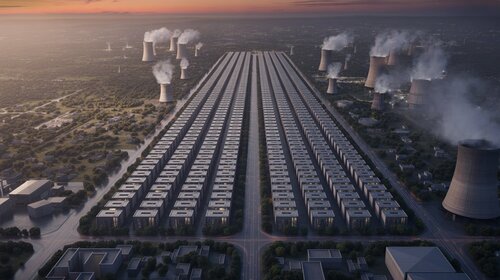
In many cases, a massive warehouse stretching across hundreds of acres, packed floor-to-ceiling with servers, processors, cooling systems, transformers, substations, diesel backup generators, industrial ventilation systems, water infrastructure, and high-voltage electrical equipment running continuously every second of every day.
These hyperscale data centers are not passive storage buildings. They are energy-intensive industrial facilities that generate enormous amounts of heat while consuming extraordinary quantities of electricity.
And now, because of the AI boom, they are multiplying at astonishing speed.
The Heat Nobody Talked About
One of the more unsettling recent developments came from researchers analyzing thousands of large AI-focused data centers around the world.
The study examined what the authors described as a “data heat island effect,” a phenomenon similar in some ways to the well-known urban heat island effect observed in large cities.
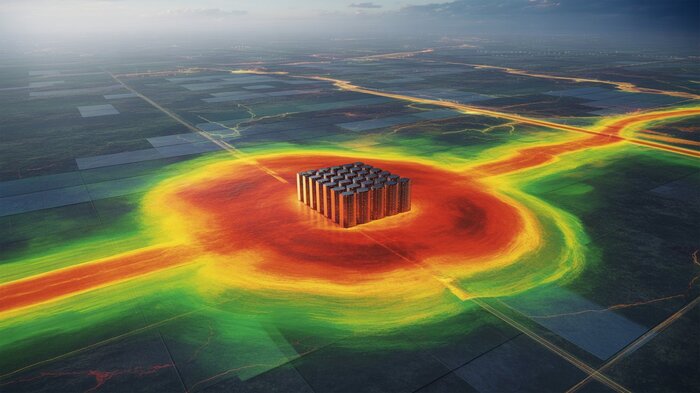
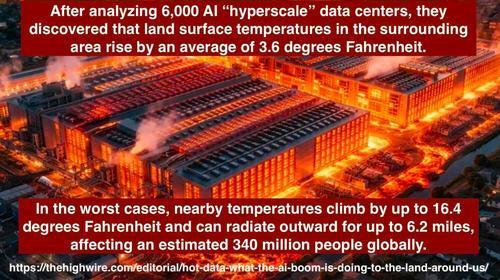
After analyzing approximately 6,000 hyperscale facilities, the researchers estimated that land surface temperatures surrounding these massive data centers increased by an average of roughly 3.6 degrees Fahrenheit after operations began. In some locations, the increase appeared substantially higher.
The warming effect, according to the researchers, could extend outward for several miles from the facilities themselves.
It is important to remain intellectually honest here. The study measured land surface temperature rather than direct human-perceived air temperature, and the research itself remains an emerging area rather than final settled doctrine.
But the broader implication is difficult to ignore.
The digital economy is not floating above the physical world. It is physically reshaping it.
And perhaps the deeper psychological issue is that many people still instinctively associate digital technology with “cleanliness.”
We see smoke coming from a factory and immediately recognize industrial activity. We see an oil refinery and understand energy consumption. But an AI prompt feels harmless because the environmental cost has been psychologically outsourced into distant infrastructure most people never see.
The modern world increasingly hides its machinery.
The AI Explosion Changed Everything
For years, data center growth remained relatively manageable because internet activity, while massive, evolved incrementally. Streaming services, online shopping, social media, and cloud computing certainly required huge infrastructure, but artificial intelligence changed the equation dramatically.
AI systems require immense computational power.
Training large language models, image-generation systems, predictive algorithms, and increasingly autonomous digital systems demands extraordinary amounts of electricity and cooling capacity. Every query processed through an advanced AI system activates a global chain of processors, storage systems, networking equipment, and cooling infrastructure.
And unlike occasional internet searches or emails, AI systems are computationally hungry by design.
This is why energy companies, utilities, infrastructure investors, and governments around the world are now scrambling to expand power generation capacity.
According to multiple forecasts, AI-related electricity demand is expected to rise so sharply that data centers may consume close to 8 percent of all electricity generated in the United States by the end of this decade.
That number becomes even more startling when translated into human terms.
Some proposed AI campuses are expected to consume electricity comparable to entire major cities.

The New Fossil Fuel Reality
And this is where the public narrative begins to fracture.
Because despite years of aggressive messaging about “net zero,” decarbonization, and reducing fossil fuel dependence, many of these AI facilities are ultimately being powered by natural gas expansion.
Not because executives are evil caricatures in a movie.
But because modern civilization still runs on reliable, scalable, continuous energy, and artificial intelligence dramatically increases the demand for exactly that kind of energy.
Several major technology projects now involve the construction of new gas-fired power plants specifically to support AI infrastructure.
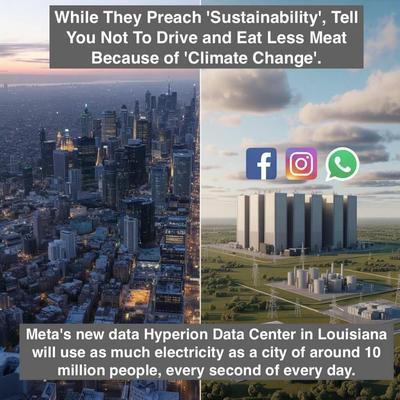
One particularly striking example involves Meta's planned Hyperion AI complex in Louisiana. Reports suggest the project may ultimately require multiple gas-fired power plants totaling several gigawatts of generation capacity, representing a major increase to regional grid infrastructure.
And this is where many ordinary people begin experiencing a profound sense of psychological dissonance.
Because they notice the contradiction.
The same institutional culture that lectures working families about reducing their personal energy use appears simultaneously willing to build enormous new industrial energy systems when the incentives involve artificial intelligence, automation, financial opportunity, military competitiveness, or technological dominance.
People can tolerate sacrifice more easily than hypocrisy.
What destabilizes public trust is not merely hardship. It is the perception that the rules are applied differently depending on who holds power.
The Water Problem Few People Understand
Electricity is only part of the story.
Modern data centers also require astonishing amounts of water for cooling purposes.
Large facilities may consume millions of gallons of water per day depending on climate conditions, cooling design, and operational intensity.
Again, the psychology here matters.
Most people do not emotionally connect their online activity with industrial water consumption. Sending emails feels disconnected from reservoirs, pipelines, cooling towers, and regional water stress.
But the physical systems remain connected whether we think about them or not.
And in some communities, residents are increasingly questioning whether local infrastructure, energy prices, water systems, and environmental burdens are being reshaped primarily to support the computational ambitions of some of the wealthiest corporations on earth.
The Hidden Cost of “Digital Life”
There is another layer to this conversation that is harder to quantify but psychologically impossible to ignore.
The modern digital economy does not merely consume energy. It consumes human attention.
The same technological ecosystem driving this unprecedented infrastructure expansion is also reshaping childhood, concentration, social behavior, sleep quality, emotional regulation, political discourse, relationships, sexuality, and mental health.
Many parents sense this intuitively now.
Children increasingly grow up immersed in algorithmic systems specifically engineered to capture and monetize attention. Adults themselves often feel psychologically exhausted by the endless stimulation cycle of modern digital life.
So the emerging discomfort many people feel toward AI infrastructure is not purely environmental.
It is existential.
People increasingly wonder whether society is constructing an enormous industrial machine whose psychological, biological, social, and environmental consequences are not fully understood even by the people building it.
The Climate Hypocrisy Machine
To be clear, none of this automatically means climate science is false.
Nor does it mean all concerns about pollution, emissions, ecological damage, or long-term environmental stress should simply be dismissed.
The world is obviously changing. Energy systems matter. Industrial civilization has consequences.
But many thoughtful people are beginning to ask a more uncomfortable question.
If climate change represents such an urgent existential emergency, why are some of the most powerful institutions in the world simultaneously constructing an entirely new layer of massively energy-intensive infrastructure?
Why are ordinary citizens repeatedly pressured to shrink their lifestyles while large corporations expand industrial energy consumption on a scale comparable to nations?
Why does sacrifice appear to flow downward while expansion flows upward?
These are not irrational questions.
They are psychologically healthy questions.
And perhaps this explains part of the growing public fatigue surrounding climate messaging itself.
People can sense inconsistency.
They can sense when moral language becomes selectively applied. They can sense when public virtue and private incentives no longer align.
And over time, trust erodes.

Every AI Prompt Has a Physical Tail
Perhaps the most important realization is also the simplest.
Artificial intelligence is not magic.
Every AI-generated image, every chatbot response, every automated system, every cloud interaction, every predictive model carries a physical cost somewhere in the real world.
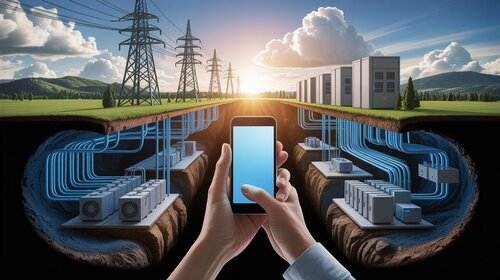
Behind the smooth interface sit power plants, transmission lines, water systems, cooling infrastructure, chip fabrication facilities, mining operations, industrial construction projects, and enormous energy demand.
The digital world is not replacing the physical world.
It is becoming one of the largest industrial systems inside it.
And whether one sees that as progress, danger, inevitability, or some combination of all three, the conversation itself deserves far more honesty than it usually receives.
Especially from the people demanding sacrifice from everyone else.
Many men reach a point where the information about prostate cancer becomes seriously overwhelming. Different opinions. Different options. No clear path forward.
If you would like to step back and think clearly before making any decisions, you are welcome to contact me. I will read your situation personally and respond thoughtfully.
No pressure. No sales pitch. Just a calm, focused exchange to help you see things clearly.
About the Author
Scott Oliver is a British writer and former Royal Marines Commando who has lived abroad since 1985. Over the last 66 years, he’s called twelve countries home, including twenty-five years in Spanish-speaking nations such as Spain, Costa Rica, and Guatemala. He has also lived in Sierra Leone, Ghana, Nigeria, Liberia, Cyprus, the USA, Grand Cayman and now lives in Mauritius.
A warrior by nature, Scott is living with prostate cancer and writing from the front lines. He speaks directly to men about health, masculinity, freedom, and strength, physically, mentally, emotionally, and sexually. His views are proudly independent: he questions conventional medicine, challenges destructive treatments, and tells the truth most men never hear.
Scott Oliver is an officially accredited member of the National Writers Union (NWU) and the International Federation of Journalists (IFJ), the world’s largest organization of professional journalists. He spent ten years on Wall Street and another decade as an offshore wealth manager, specializing in globally diversified, multi-currency hedge fund portfolios. He is the author of What If Cancer’s Best Defense Is Free? — Sleep as a Defense Against Cancer: A Former Royal Marines Commando’s 4,000-Hour Research Roadmap, where he reveals how sleep repairs DNA, restores immunity, and strengthens your fight against cancer. He’s also the author of books on offshore investing and Costa Rica real estate and has written thousands of articles in English and Spanish on living abroad with courage, clarity, and conviction.
You can always contact Scott Oliver here with your questions and suggestions.
Expert Resources
- The Data Heat Island Effect: Quantifying the Impact of AI Data Centers in a Warming World
Emerging academic research examining possible land-surface warming effects surrounding hyperscale AI data centers.
Read the study - World Resources Institute: How Data Centers Affect US Communities
A detailed overview of the impact data centers may have on electricity demand, water consumption, air quality, land use, and local communities.
Read at the World Resources Institute - Brookings Institution: The Future of Data Centers
An analysis of the economic, technological, infrastructure, and policy implications of rapid data center expansion.
Read at Brookings - CNBC: AI Could Drive a Natural Gas Boom
A report examining how rising AI electricity demand may increase dependence on natural gas generation in the coming decade.
Read at CNBC - CNN: Scientists Found an Alarming Environmental Impact of Vast Data Centers
A mainstream overview discussing concerns about the environmental footprint of hyperscale data infrastructure.
Read at CNN