The Quiet Power of Palantir: How Data, Not Force, May Shape the Future of Control
Most people still think power looks like tanks, missiles, or soldiers on the ground. But today, a growing number of observers are beginning to worry about something far less visible.
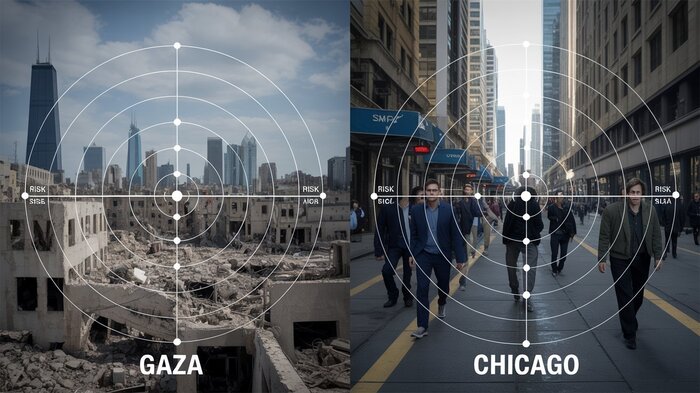
They are looking at places like Gaza, where the advanced data systems of companies help military forces identify, prioritize, and act on targets in real time, and they are asking a simple but deeply unsettling question: if this kind of infrastructure is already being used in an active war zone, what happens when the same company becomes deeply embedded inside the institutions of government at home?
That company is Palantir.
Palantir presents itself as a software company. It does not manufacture bombs. It does not formally command troops. It does not write laws. Yet that description misses the real source of its power.
Palantir sits at the level where reality is sorted, filtered, organized, and presented to decision makers. It helps shape the information that military commanders, intelligence officials, police forces, tax authorities, border agencies, and health bureaucracies rely on when they act.
And that is why its influence deserves far more scrutiny than it gets.
The core issue is not that Palantir needs to falsify anything. It does not. Palantir does not need to manipulate data to influence decisions. By shaping how data is organized, prioritized, and presented, it can influence the narrative that decision makers rely on. In complex systems, that can be just as powerful as direct control.
Modern governments are drowning in information. Satellite imagery, drone feeds, intelligence intercepts, logistics streams, biometric records, health databases, border crossings, tax filings, police reports, and financial transactions all pour in at a scale no human team can truly process on its own.
So institutions lean on platforms that simplify reality for them. They want a dashboard. They want an alert. They want a score. They want a system that tells them what matters most and what can safely be ignored.
That is where Palantir comes in.
Its systems turn massive volumes of raw information into something more usable and more dangerous. They create a structured picture of the world. They elevate some signals. They reduce others. They establish what feels urgent, what seems risky, and what looks actionable. No one needs to invent facts. The framing itself does the work.
This matters enormously in military settings. A system that emphasizes caution, uncertainty, and civilian exposure will not produce the same operational mood as one that emphasizes speed, threat signals, and target opportunity. Both may draw on the same underlying data. But they can lead decision makers toward very different outcomes.
That is why critics worry that a company with experience supporting military operations, including work connected to Israel's defense establishment during the Gaza war, could bring the same logic of high speed target driven analysis into domestic government systems in the United States.
And when people look at Palantir's footprint inside Washington, that concern no longer feels abstract.

The Contract Trail
Palantir's defenders sometimes speak as if this is just one contractor among many. The public record suggests something much bigger. The company has built a sprawling contract footprint across the U.S. military, intelligence environment, public health bureaucracy, immigration enforcement apparatus, tax system, diplomatic system, and local policing.
Some figures below are ceilings rather than guaranteed spend. Some are cumulative totals. Some are reported estimates where full disclosure is limited. But taken together, they show a pattern that is difficult to ignore.
Start with the U.S. Army. In July 2025, the Army announced an enterprise agreement with Palantir that can run up to ten billion dollars over ten years. The stated purpose was to consolidate roughly seventy five existing contract vehicles and make Palantir's commercial software easier to buy across the Army and other Defense Department components. In plain English, this was not a niche award. It was a move toward making Palantir a central part of the Army's software and data backbone.
That did not appear out of nowhere. In May 2025, Palantir received a seven hundred ninety five million dollar Maven Smart System award modification for software licenses tied to a core military AI system. Before that, public reporting in 2024 described a four hundred eighty million dollar Pentagon Maven prototype deal. By 2026, reporting indicated that Maven related work had grown into a broader Pentagon relationship with a value of roughly one point three billion dollars. In September 2024, Palantir also announced an expansion of Maven Smart System capabilities across the military services worth up to ninety nine point eight million dollars over five years.
Then there is TITAN, the Army's Tactical Intelligence Targeting Access Node. In March 2024, Palantir won a one hundred seventy eight point four million dollar prototype maturation agreement to develop ten TITAN systems. TITAN is not just another office database. It is built to fuse intelligence and help turn sensing into targeting. That is exactly the kind of contract that worries people who fear the spread of military logic into broader state systems.
Palantir's Army work also includes the Army Vantage program. Public figures previously cited placed a December 2023 extension at one hundred fifteen point zero four million dollars. A later 2024 expansion pushed total available value much higher, with public reporting citing an agreement of more than four hundred million dollars and a ceiling above six hundred eighteen million dollars. That matters because Vantage is fundamentally about data management, operational visibility, and turning information into decisions across the Army.
In September 2022, the U.S. Army Research Laboratory extended Palantir's work through a contract worth up to two hundred twenty nine million dollars over one year, supporting broader AI and machine learning use across the Armed Services, Joint Staff, and Special Forces. Earlier still, in January 2021, Palantir was selected to deliver a prototype for the Army's ground station modernization effort. That phase was worth about eight point five million dollars, but the broader multi phase effort was described as having potential value of roughly two hundred fifty million dollars.
The company's reach extends well beyond the Army. In December 2021, Space Systems Command awarded Palantir a forty three million dollar extension, taking that contract's face value to roughly ninety one point five million dollars. In June 2022, Palantir announced a further expansion of its Space Systems Command relationship, bringing total value to roughly one hundred seventy five point four million dollars. These are not side projects. They tie Palantir into high end military decision systems linked to space, battle management, and command support.
Now move from warfighting to homeland systems. In early 2026, the Department of Homeland Security reportedly opened a blanket purchasing agreement with Palantir worth up to one billion dollars over five years. On top of that, Homeland Security Investigations renewed a major case management relationship with Palantir in 2022 for roughly ninety five and a half to ninety five point nine million dollars over five years, depending on the source. USA spending also shows an ICE related investigative case management award with about one hundred forty five million dollars currently obligated and a potential total award amount of about one hundred seventy six point five million dollars.
Palantir's immigration work goes even deeper. Public reporting in 2025 described an ImmigrationOS contract of roughly twenty nine point eight million dollars tied to immigration lifecycle management and tracking. In practical terms, that means Palantir has not just touched immigration enforcement. It has become part of the digital machinery that helps make deportation, case tracking, and investigative sorting possible.
The public health side is just as striking. In December 2022, the Centers for Disease Control and Prevention announced a five year contract worth four hundred forty three million dollars for a common operating picture platform tied to public health preparedness. Before that, the CDC had already partnered with Palantir on a six month COVID response contract worth five point three million dollars and a one year disease monitoring and outbreak response renewal worth seven point four million dollars. The numbers are different, but the underlying pattern is the same: Palantir was brought in to organize data, connect systems, and support operational decisions in a highly sensitive domain.
The National Institutes of Health also continued collaboration with Palantir on the National COVID Cohort Collaborative. Public figures initially put that work at thirty six million dollars over one year, later extended to around sixty million dollars in total. The Department of Health and Human Services added a ninety million dollar five year blanket purchase agreement that made Palantir's platform available across the department's many agencies and missions. The Food and Drug Administration then partnered with Palantir on its 21 Forward initiative in a deal valued at about twenty two million dollars, focused on food supply chain resilience and modernization.
If Palantir's role ended with defense and health, that would already be extraordinary. But it does not. The Internal Revenue Service has used Palantir technology since 2014, and recent reporting said the company has accumulated more than two hundred million dollars in IRS awards and obligated payments. In 2025, the IRS reportedly paid Palantir one point eight million dollars for a pilot called SNAP, the Selection and Analytic Platform, intended to improve how the agency flags high value audit and fraud cases. That may sound administrative, but it means Palantir is also becoming part of the machinery that helps decide who gets examined by the tax state.
The State Department appears in the record as well. Earlier reporting described a State Department software deal worth up to ninety nine point six million dollars. Other later contract reporting pointed to a smaller award in the neighborhood of nine point nine million dollars for platform license and support services. The precise mix of State Department awards is less clear in public reporting than some of the Army and CDC figures, but it is enough to show that Palantir's presence extends into diplomatic and foreign affairs channels too.
And then there is policing. Public transparency is weaker at the state and local level, but enough has surfaced to show the pattern. Reporting on the New York Police Department suggested Palantir's work may have cost roughly three point five million dollars per year, implying something like seventeen point five million dollars over five years. In Los Angeles, reporting described a two point nine million dollar contract related to the police department's automated license plate reader system. In California, a Palantir contract of roughly three hundred forty thousand dollars was linked to infrastructure for a statewide license plate database effort. New Orleans has also been repeatedly cited as a city where Palantir's predictive policing technology was used, even though public contract values are far less clear.
Step back and look at the pattern. Army. Pentagon. Space Systems Command. Homeland Security. ICE. HSI. CDC. NIH. HHS. FDA. IRS. State Department. NYPD. LAPD. State and regional intelligence and policing systems. This is not a narrow contractor relationship. It is not a one agency story. It is not a temporary pilot on the edge of government. Palantir has positioned itself inside the data layer of state power.

The Contracts Which Are Public
- U.S. Army Enterprise Agreement — Up to $10 billion over 10 years. Nature: enterprise-wide software and data agreement intended to consolidate about 75 contract vehicles into one framework for Army software, data, and AI needs.
- Maven Smart System
- May 2025 award modification — $795 million. Nature: software licenses and support for the Maven Smart System, an AI enabled military intelligence and targeting analysis platform.
- 2024 prototype deal — $480 million. Nature: Pentagon and Army Maven prototype work for identifying points of interest and supporting operational intelligence analysis.
- September 2024 expansion — Up to $99.8 million over 5 years. Nature: expansion of Maven Smart System AI and machine learning capabilities across military services.
- TITAN — $178.4 million. Nature: prototype maturation contract for the Army's Tactical Intelligence Targeting Access Node system, designed to fuse intelligence and support targeting workflows.
- Army Vantage — Publicly cited at $115.04 million for a December 2023 extension. Nature: continued support for the Army Vantage data platform for operational visibility, analytics, and decision support.
- U.S. Army Research Laboratory — Up to $229 million over 1 year. Nature: delivery of Palantir AI and data software for Army Research Lab and related defense users.
- Army Ground Station Modernization Prototype — About $8.5 million for the phase, with roughly $250 million potential across multiple phases. Nature: prototype work for Army ground station modernization.
- Space Systems Command
- December 2021 extension — $43 million, bringing the contract's cumulative face value at that point to about $91.5 million.
- June 2022 expansion — Total value brought to about $175.4 million. Nature: software and decision support for space related defense operations.
- Department of Homeland Security blanket purchasing agreement — Reported at up to $1 billion over 5 years. Nature: department-wide access to Palantir software, maintenance, and implementation services for DHS components.
- Homeland Security Investigations renewal — About $95.5 million to $95.9 million over 5 years. Nature: Investigative Case Management software and support for HSI, a division of ICE.
- ICE Investigative Case Management award — $145 million current award amount, with about $176.5 million potential award amount. Nature: investigative case management, maintenance, support, and custom enhancements.
- ICE ImmigrationOS — Roughly $29.8 million to $30 million. Nature: immigration tracking and lifecycle management platform intended to support identification, tracking, and deportation related workflows.
- CDC Common Operating Picture — $443 million over 5 years. Nature: public health preparedness and disease surveillance data platform.
- CDC COVID response contract — $5.3 million for 6 months. Nature: COVID response data support.
- CDC disease monitoring and outbreak response renewal — $7.4 million for 1 year. Nature: continued support for disease monitoring and outbreak response systems.
- NIH National COVID Cohort Collaborative — Initially $36 million over 1 year, later extended to about $60 million total. Nature: health data collaboration and analytics platform.
- HHS contract vehicle — $90 million over 5 years. Nature: Department of Health and Human Services wide access to Palantir platform services.
- FDA 21 Forward initiative — About $22 million. Nature: food supply chain resilience and data modernization.
- IRS work
- IRS cumulative awards — Public reporting has said Palantir accumulated more than $200 million in IRS awards since 2014.
- 2025 SNAP pilot — About $1.8 million. Nature: Selection and Analytic Platform to improve case selection and analytics for audits and fraud work.
- State Department
- Earlier reported software deal — Up to about $99.6 million.
- Later reported platform license and support award — About $9.9 million.
- Nature: platform licensing and support services for State Department functions.
- NYPD — Reporting suggested about $3.5 million per year, implying around $17.5 million over 5 years. Nature: data analysis and policing support systems. Public transparency is limited.
- LAPD — About $2.9 million. Nature: support tied to automated license plate reader related policing systems.
- California statewide license plate database infrastructure — About $340,000. Nature: infrastructure support for a statewide plate reader database effort.
- New Orleans Police Department — Use of Palantir predictive policing tools has been widely reported, but I did not find a solid public contract value I would treat as reliable enough to state as fact.

Why This Should Worry More People

Some people will respond by saying that none of this means Palantir is making final decisions. Formally, that is true. Military officers still authorize strikes. Officials still sign warrants. Bureaucrats still make policy. Auditors still decide what to pursue. But that answer misses the real issue.
In complex systems, the actor that shapes the information environment can shape the decisions made inside it. If a platform determines which data points are surfaced first, which people are scored as higher risk, which relationships are highlighted, and which uncertainties are compressed into a clean visual summary, then it is not merely passively storing data. It is shaping the narrative through which reality is understood.
That influence can be subtle. It may appear neutral because it is numerical. It may feel objective because it comes wrapped in software. But selection, prioritization, and presentation are never trivial. They establish context. They guide attention. They create a mood of caution or urgency. They can tilt a system toward restraint or toward action.
That is why the debate over Palantir cannot be reduced to a childish question of whether the company is directly pulling a trigger or personally making arrests. The more serious question is whether a private contractor should be allowed to become so deeply embedded across so many domains that its framing of reality becomes the default operating picture for the state itself.
History suggests that powerful tools rarely remain confined to their original mission. Systems built to fight terrorists migrate into border control. Systems justified by public health emergencies become part of administrative governance. Tools designed for military targeting produce ideas and habits that can later be applied to civilians, dissidents, and ordinary people who simply happen to fall inside a bureaucratic category.
And once an institution becomes dependent on a platform, it becomes hard to challenge it. The software is embedded. The users are trained. The dashboards become routine. The language of efficiency and modernization takes over. Questions about freedom, proportionality, bias, and abuse begin to sound old fashioned or naïve. That is often the point at which the most important safeguards start to weaken.
None of this requires a conspiracy. It requires only scale, dependency, and habit.
That is why Palantir deserves close scrutiny now, not later. Not because it is the only contractor in government. Not because every contract means abuse. But because when one company becomes deeply embedded in defense, intelligence, immigration, public health, taxation, diplomacy, and policing all at once, society has every right to ask what kind of state is being built around it.
If the company's defenders are right, then strong oversight, transparency, and democratic accountability should not threaten its mission. They should strengthen it. But if these systems continue to spread without meaningful public debate, independent audit, and hard legal limits, then the danger is obvious.
The future of control may not arrive with jackboots or dramatic speeches. It may arrive through procurement notices, software renewals, data integrations, and dashboards that quietly define the world for those in power.
And by the time most people understand how much influence lives at the data layer, the architecture may already be in place.
About the Author
Scott Oliver is a British writer and former Royal Marines Commando who has lived abroad since 1985. Over the last 66 years, he’s called twelve countries home, including twenty-five years in Spanish-speaking nations such as Spain, Costa Rica, and Guatemala. He has also lived in Sierra Leone, Ghana, Nigeria, Liberia, Cyprus, the USA, Grand Cayman and now lives in Mauritius.
A warrior by nature, Scott is living with prostate cancer and writing from the front lines. He speaks directly to men about health, masculinity, freedom, and strength, physically, mentally, emotionally, and sexually. His views are proudly independent: he questions conventional medicine, challenges destructive treatments, and tells the truth most men never hear.
Scott Oliver is an officially accredited member of the National Writers Union (NWU) and the International Federation of Journalists (IFJ), the world’s largest organization of professional journalists. He spent ten years on Wall Street and another decade as an offshore wealth manager, specializing in globally diversified, multi-currency hedge fund portfolios. He is the author of What If Cancer’s Best Defense Is Free? — Sleep as a Defense Against Cancer: A Former Royal Marines Commando’s 4,000-Hour Research Roadmap, where he reveals how sleep repairs DNA, restores immunity, and strengthens your fight against cancer. He’s also the author of books on offshore investing and Costa Rica real estate and has written thousands of articles in English and Spanish on living abroad with courage, clarity, and conviction.
You can always contact Scott Oliver here with your questions and suggestions.