10 Questions That Reveal If Your Husband’s Doctor Really Knows the Science
When a man hears the words “You have prostate cancer,” fear often takes over. Many men immediately think they are going to die, and too often, doctors reinforce this fear by presenting surgery or radiation as the only safe path forward.
But here is what every wife must know: prostate cancer, when caught early, is rarely an emergency. Most men do not die from it, and many live long, healthy lives without aggressive treatment.
Still, not every urologist will give you the full picture. That's why your role is critical. The right questions can reveal whether your husband's doctor is fully informed—or simply pushing him toward unnecessary treatment.

Here are 10 questions that will help you protect the man you love.
- “Doctor, how many men actually die from prostate cancer when it's caught early?”
Why this matters: The latest evidence shows that only about 3% of men die from prostate cancer within 15 years when diagnosed early. That means the odds are strongly in your husband's favor. If the urologist suggests the disease is always a death sentence, he's not reflecting reality. - “Does rushing into surgery or radiation extend a man's life compared to careful monitoring?”
Why this matters: The largest study ever done on this shows no survival advantage for immediate surgery or radiation compared to monitoring. If the doctor claims surgery will “save your husband's life,” press him to explain why the evidence doesn't show that. - “What are the risks and side effects of each treatment compared to monitoring?”
Why this matters: Surgery and radiation can reduce disease progression, but the price is often urinary incontinence, erectile dysfunction, and bowel problems. Monitoring avoids these harms in many men. A good doctor should lay out these trade-offs clearly. - “How many men are able to live 10 or 15 years without ever needing treatment?”
Why this matters: In long-term studies, about one in four men never needed surgery or radiation at all. They lived normal lives without side effects. If your doctor doesn't mention this possibility, he may be leaving out vital information. - “If we choose monitoring, what is the real risk of spread—and what happens if it does?”
Why this matters: Yes, men in monitoring groups show more spread (metastases), but that has not translated into higher death rates. And today, powerful new treatments can be started later if needed. A well-informed urologist will explain this distinction.
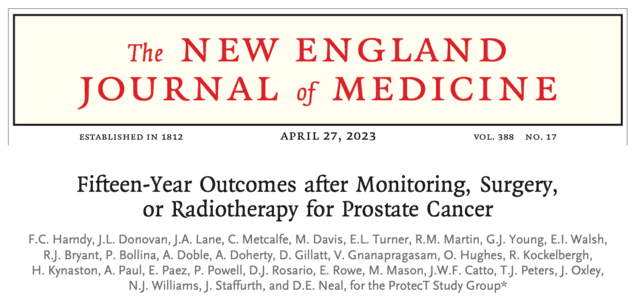
 The New England Journal of Medicine Study.
 - “How do you help men balance survival with quality of life?”
Why this matters: For many men, staying alive isn't the only goal. Avoiding diapers, maintaining sexual function, and living with dignity matter just as much. If the doctor only talks about survival statistics, he may be ignoring what truly matters to your husband. - “Doctor, what percentage of your own patients choose monitoring versus surgery or radiation?”
Why this matters: This question quickly reveals whether the urologist values all options—or tends to push every patient toward surgery. If almost all his patients have surgery, that tells you he may be biased, not balanced. - “What would you personally do if you were in my husband's shoes?”
Why this matters: Doctors often avoid this question, but it puts them on the spot. A urologist who is confident in the science will admit that many men have the luxury of time. If he pressures you with fear instead, that's telling. - “Are there other specialists we should talk to before making a decision?”
Why this matters: A good doctor will encourage second opinions—perhaps with radiation oncologists or active surveillance experts. If your urologist discourages seeking outside perspectives, be cautious. That's often a sign of ego or financial interest. - “Can you show us the most recent research that supports your recommendation?”
Why this matters: You don't have to name the study. Just ask for the science behind his advice. If he struggles to provide it, you've learned what you need to know.How to Stay Calm and Think Clearly After a Prostate Cancer DiagnosisGet instant access to your free guide now.Join FreeNo spam. Unsubscribe anytime.
Prostate Cancer Warrior's Conclusion: You Are His Strongest Ally
To the wives reading this: you are not being difficult—you are being wise. Many men are too scared or too trusting to push back against a doctor's recommendation. By asking these 10 questions, you become your husband's shield.
To the husbands: prostate cancer may feel terrifying, but the numbers are on your side. Nearly all men with early prostate cancer live long, full lives—whether they choose surgery, radiation, or simply monitoring.
You both have time. Time to ask questions, time to think, and time to make the choice that protects not just his life, but his manhood, your marriage, and your future together.

About the Author
Scott Oliver, 66, is living well with prostate cancer after dedicating more than 4,000 hours to researching the condition. His first goal is to help men reduce their risk of developing prostate cancer through proven lifestyle strategies.
When diagnosed, his mission is to help men avoid unnecessary prostate surgeries that can lead to devastating complications such as incontinence, bleeding, permanent impotence, and a loss of length.
Scott Oliver is not a doctor and does not offer medical advice; however, he is healthier and fitter than he has been in decades. Through his articles and videos, he shares hard-to-find, uncensored information on proven alternative therapies, effective fitness methods, and repurposed drugs, content that most doctors won’t mention and search engines suppress.
He is an accredited member of the National Writers Union (NWU) and the International Federation of Journalists (IFJ), the world’s largest organization of professional journalists. Scott is also the author of What If Cancer’s Best Defense Is Free? Sleep as a Defense Against Cancer: A Former Royal Marines Commando’s 4,000-Hour Research Roadmap, where he reveals how sleep repairs DNA, restores immunity, and strengthens the body’s natural defenses against cancer.
You can always contact Scott Oliver here with your questions and suggestions.
Expert Resources Used By Scott Oliver To Research and Write This Article:
Fifteen-Year Outcomes after Monitoring, Surgery, or Radiotherapy for Prostate Cancer. https://www.nejm.org/doi/full/10.1056/NEJMoa2214122