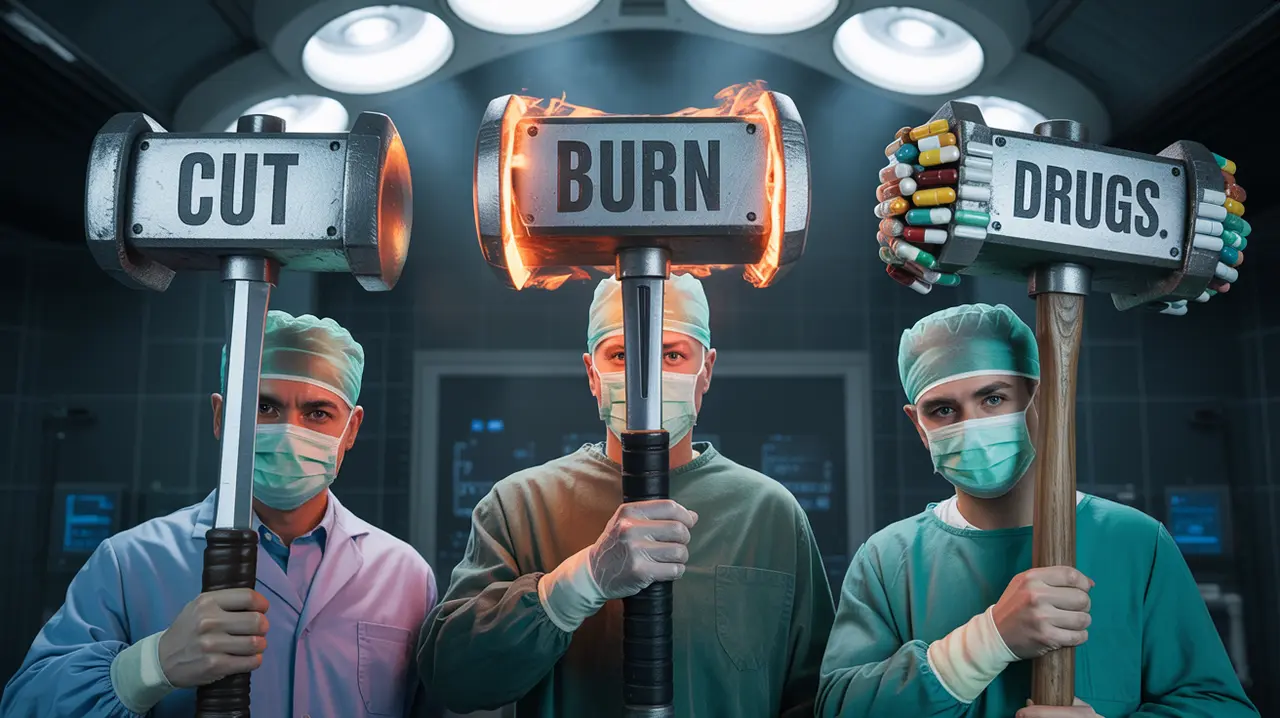
The Three Hammers: Why Every Man Must Think Twice Before Surrendering to Prostate Cancer Treatment
There's an old saying: when all you have is a hammer, every problem looks like a nail. That saying could have been written about modern medicine, especially prostate cancer.
The truth is simple: surgeons cut, radiologists burn, and oncologists drug. Each has their hammer. And when you walk into their office with a diagnosis, you're the nail.
But what if none of those hammers is the right tool for you?

The Surgeon's Hammer: Cut
Surgeons are trained to operate. It's what they know, it's what they do, and it's how they make their living. For many, the scalpel is the only answer.
That's why, every year, tens of thousands of men have their prostates removed in operations that even some top surgeons admit were unnecessary.
On paper, a radical prostatectomy sounds like decisive action. In reality, it often leaves men with lifelong consequences:
- Incontinence: the loss of control over urination.
- Erectile dysfunction: the loss of sexual function that can damage confidence and relationships.
- Permanent changes to quality of life.
Cutting may look like courage, but it often creates wounds that never fully heal.

The Radiologist's Hammer: Burn
If the surgeon's instinct is to cut, the radiologist's instinct is to burn. Radiation therapy is often framed as “less invasive.” It promises no knife, no scars, no overnight hospital stays.
But radiation has its own silent costs. The beams that destroy cancer cells can also damage healthy tissues around them. The effects may not show up right away, but years later, men report problems such as:
- Fatigue that lingers.
- Bowel or bladder issues from collateral tissue damage.
- Secondary cancers that develop in previously healthy tissue.
Radiation is marketed as the gentle option. It rarely feels that way when you live through the long-term fallout.

The Oncologist's Hammer: Drugs
Finally, the oncologist's hammer: drugs. In prostate cancer, this usually means hormone therapy — also called androgen deprivation therapy (ADT).
Doctors often describe it as “slowing the disease” or “holding it in check.” In reality, it works by chemically castrating the body, shutting down testosterone.
The side effects are often devastating:
- Loss of libido and sexual function.
- Rapid weight gain and loss of muscle mass.
- Bone thinning, hot flashes, and fatigue.
- Increased risk of heart disease and depression.
It's sold as “control.” Too often, it steals a man's vitality while leaving the cancer problem unsolved.
The Problem With Hammers
Surgeons are not villains. Radiologists are not monsters. Oncologists are not evil. They are each experts in their craft. But their craft is narrow.
- The surgeon sees a problem and thinks: cut it out.
- The radiologist sees the same problem and thinks: burn it out.
- The oncologist sees it and thinks: drug it out.
Each believes in their hammer. And when you sit in their office, you become the nail.
That's why so many men end up on the conveyor belt: biopsy, diagnosis, hammer. Few are told they have other choices. Fewer still are told that time is on their side.

What If None of Them Is Right for You?
Here's the good news: in most cases, prostate cancer is not an enemy charging at you with bayonets fixed. It's slow, cautious, and often poses no immediate threat.
That means you don't have to surrender to the first hammer offered. You have time. You have space. You have options.
The intelligent warrior knows the best first move is sometimes no move at all. Holding your ground, gathering intelligence, and strengthening your defenses can be the wisest strategy.
The Warrior's Alternative Arsenal
Real warriors don't fight with only one weapon. They prepare an arsenal. For prostate cancer, that means exploring options beyond cut, burn, and drug.
- Active Surveillance: regular monitoring rather than immediate intervention. Safe for many men with low-risk cancers.
- MRI and Advanced Imaging: looking at the whole prostate rather than stabbing at random with a biopsy needle.
- Lifestyle as Weaponry: sleep, nutrition, fasting, supplements, and exercise — proven tools for strengthening the body's defenses.
- Partnership: involving your wife or partner as an ally in decision-making, not keeping her in the dark.
- Multiple Opinions: asking not just “what can you do to me?” but “what's best for me?”
This is what it means to think and act like an intelligent warrior.
A Tactical Checklist
Before you let anyone swing a hammer, ask yourself — and your doctor — these questions:
- What are the chances my cancer will actually harm me if I do nothing right now?
- What are the side effects of this treatment in 1 year, 5 years, and 10 years?
- What are the alternatives to surgery, radiation, or hormone therapy?
- What evidence do you have that I need this treatment today?
The answers will tell you whether you're making a wise decision — or simply becoming the nail beneath someone's hammer.
Closing Rally
The medical system will always present you with hammers. Cutting. Burning. Drugging. That's what it knows, that's what it sells, and that's what it profits from.
But you are not a nail. You are not a passive patient.
You are a warrior. An intelligent warrior.
And your job is not to hand your body over to the first man with a hammer. Your job is to study, to prepare, and to choose your battle on your own terms.
Because the strongest warriors don't just fight hard. They fight smart.
About the Author
Scott Oliver, 66, is living well with prostate cancer after dedicating more than 4,000 hours to researching the condition. His first goal is to help men reduce their risk of developing prostate cancer through proven lifestyle strategies.
When diagnosed, his mission is to help men avoid unnecessary prostate surgeries that can lead to devastating complications such as incontinence, bleeding, permanent impotence, and a loss of length.
Scott Oliver is not a doctor and does not offer medical advice; however, he is healthier and fitter than he has been in decades. Through his articles and videos, he shares hard-to-find, uncensored information on proven alternative therapies, effective fitness methods, and repurposed drugs, content that most doctors won’t mention and search engines suppress.
He is an accredited member of the National Writers Union (NWU) and the International Federation of Journalists (IFJ), the world’s largest organization of professional journalists. Scott is also the author of What If Cancer’s Best Defense Is Free? Sleep as a Defense Against Cancer: A Former Royal Marines Commando’s 4,000-Hour Research Roadmap, where he reveals how sleep repairs DNA, restores immunity, and strengthens the body’s natural defenses against cancer.
You can always contact Scott Oliver here with your questions and suggestions.
Expert Resources Used By Scott Oliver To Research and Write This Article:
- AUA/ASTRO Guidelines on Clinically Localized Prostate Cancer – defines active surveillance and its role in delaying or avoiding definitive treatment. auanet.org
- Hopkins Medicine – Active Surveillance for Prostate Cancer – explains the recommended monitoring approach, its rationale, and how it's implemented. hopkinsmedicine.org
- NCI Fact Sheet: Hormone Therapy for Prostate Cancer – describes how hormone therapy works and lists its side effects. cancer.gov
- Cancer Research UK – Long-Term Side Effects of Radiotherapy – outlines delayed adverse effects from prostate radiotherapy on urinary, bowel, and sexual function. cancerresearchuk.org
- Personalized Decision Making for Biopsies in Prostate Cancer Active Surveillance Programs – models how to reduce biopsy burden by personalizing schedules. arxiv.org
- PMC Article: Active Surveillance in Localized Prostate Cancer – reviews how active surveillance programs monitor patients and avoid overtreatment. pmc.ncbi.nlm.nih.gov
- Mayoclinic – Hormone Therapy for Prostate Cancer – presents risks and side effects of hormone therapy, in clinical language for patients. mayoclinic.org
- NIH “Comparing Side Effects After Prostate Cancer Treatment” – discusses differences in side effect profiles across treatment modalities, and the rationale for surveillance versus intervention. nih.gov