
When the Algorithm Says "No".
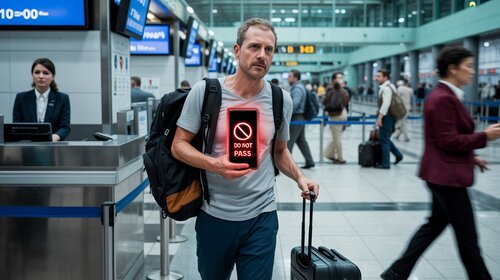
I once watched freedom disappear at an airport counter. A man held out his phone, confused, as the agent's smile stiffened. His travel app showed a red warning, no boarding pass, no explanation. She told him to call the helpline, a number that rang forever and never answered.
He just stood there, suspended between worlds, while the rest of us kept walking. I didn't know it then, but I was watching the future, the quiet moment when a system, not a person, decides who may move and who may not.
The algorithm says “No”.
That moment stayed with me. I've seen how systems decide who gets access. In the hospital world, machines already choose which patients qualify for treatments, loans, or benefits. Now the same logic is expanding everywhere. It's quiet, efficient, and absolute.
From Law to Code
For centuries, freedom depended on laws. If someone denied you service or seized your assets, you had recourse: courts, appeals, the rule of law. Today decisions are made not by humans but by clearance systems—the invisible networks that approve or reject transactions in milliseconds. If your payment fails, your benefits pause, or your ID doesn't match...
... The algorithm says “No”.
What makes this so dangerous is that the infrastructure is already built. Governments, banks, and technology companies have spent decades constructing a world where every action leaves a digital trace. In good hands, that can create transparency. In the wrong hands, it becomes control.
The Rails of Governance
Engineers describe seven layers—or “rails”—that now link identity, finance, and regulation: standards, digital identity, data telemetry, accreditation, audit, procurement, and finance.
Together they form a global operating system for policy enforcement. Add AI and real-time payments, and that system can govern by permission rather than by law.
If a crisis hits—a pandemic, cyberattack, or climate emergency—these rails can be switched from passive monitoring to active enforcement overnight. You wouldn't need new legislation; you'd only need a software update.

Eighteen Windows Into Our Future
I've spent many decades tracing how these mechanisms touch ordinary life. Here's what I see coming.
- Banking and Finance: A man taps his card at the supermarket checkout; the screen flashes red. His balance is fine, but an algorithm has re-scored his “risk profile.” The cashier only shrugs as the queue behind him grows.
When payment systems enforce compliance automatically, access to money becomes a function of behaviour, not balance. - Healthcare Access: A woman with chest pain tries to book an appointment, but her digital-ID app refuses to verify because her insurance premium lapsed two days earlier. The receptionist can't override the system.
When eligibility is determined by code, compassion can't override compliance. - Employment and Business: A contractor refreshes a government portal and watches his company's status flick from “eligible” to “non-compliant.” A missing sustainability certificate, updated overnight, erases twenty years of work.
Automated procurement rules turn lifelong reputations into single-line database errors. - Travel and Mobility: At the airport gate a young family's boarding passes glow red: their carbon-travel quota has been reached for the month. The flight leaves without them.
Freedom of movement becomes conditional when every journey requires algorithmic permission. - Speech and Expression: A journalist publishes an investigative piece; minutes later, ad revenue drops to zero. Payment processors have flagged the article as “brand unsafe.” No one will say why.
When infrastructure, not law, decides who can speak, free speech survives only at the platform's discretion. - Social Services and Welfare: A single mother wakes to find her benefit payment frozen. The message on her phone says “fraud review pending.” She has no idea what triggered it.
Automated welfare enforcement replaces due process with silent exclusion. - Education and Credentialing: A student's online learning dashboard displays a warning: “engagement score below threshold.” The algorithm recommends suspension. Teachers no longer review cases manually.
When algorithms grade compliance instead of knowledge, education becomes obedience training. - Central Bank Digital Currencies: A pensioner tries to withdraw cash; the teller explains that physical currency has been phased out. His digital wallet limits spending on “non-essential” goods. His savings obey new rules he never agreed to.
Programmable money turns economic freedom into a revocable privilege. - Carbon Tracking and Personal ESG Scores: An electric-vehicle owner receives an alert: “Monthly carbon limit exceeded.” Charging is temporarily disabled until next cycle. The dashboard congratulates him for “responsible consumption.”
Environmental scoring becomes a mechanism of behavioural control when limits replace incentives.How to Stay Calm and Think Clearly After a Prostate Cancer DiagnosisGet instant access to your free guide now.Join FreeNo spam. Unsubscribe anytime. - AI-Driven Law Enforcement: Police drones hover above a park, cameras identifying “anomalous gatherings.” A man is questioned because his movement pattern resembles a protest organiser's route.
Predictive policing replaces the presumption of innocence with algorithmic suspicion. - Digital Censorship Infrastructure: A community website vanishes overnight. Hosting support emails a link to “updated content-moderation standards.” The archive of local stories is gone forever.
Censorship by infrastructure erases speech without headlines or trials. - Automated Taxation and Smart Contracts: A freelancer checks her bank app; yesterday's payment is smaller than agreed. The new tax-withholding algorithm has “pre-collected” estimated dues. Appeals take six months.
Automation without accountability transforms taxation into continuous extraction. - Borderless Data Sharing: A traveller denied entry in one country tries another, only to find the rejection has followed him. A single data field labelled “non-compliant” replicates worldwide.
Global interoperability means that one denial can become universal exile. - AI-Based Employment Screening: An applicant never receives a response after submitting his résumé. Unknown to him, facial-analysis software judged his recorded interview “low confidence.”
Invisible algorithms quietly redraw who is employable and who is invisible. - Smart Cities and IoT Control: In a gleaming city centre, access gates scan faces for entry to public transport. When the network goes down, thousands of commuters are stranded behind invisible walls.
When every movement depends on data, a system glitch becomes a lockdown. - Insurance and Genetic Profiling: A woman renews her health insurance; premiums triple. Her fitness tracker flagged irregular sleep, and her genealogy kit revealed a “moderate risk” gene. She regrets ever sharing the data.
Health transparency without consent turns prevention into punishment. - Humanitarian and Welfare IDs: In a refugee camp, food distribution pauses. Servers can't connect to the central ID database. Families wait in heat while staff whisper that expired credentials can't be overridden.
Digital dependency makes survival conditional on connectivity. - The Consultant Class: In a conference hall, consultants unveil new compliance software. Governments, banks, and NGOs applaud. Outside, the people who must live by those rules have no seat at the table.
The architects of control are never those who must live under it.
Individually, each system promises efficiency. Together they create total dependency.

Freedom by Permission
What terrifies me is not the technology itself but its architecture of obedience.
When every vital service runs through conditional clearance, freedom ceases to be a right and becomes a privilege. The Dutch childcare-benefit disaster proved this. The system worked “as designed” while destroying thousands of families. No one meant harm; the code simply followed orders.
Now scale that principle to the global level and connect it to programmable money. Whoever controls the clearance switch controls society.

Why This Matters to Me
More than forty years ago, when I served in the Royal Marines Commandos, I met a few men whose work kept them permanently in the shadows. They were deep-cover operatives who understood how power really works behind the polished surfaces of politics and policy.
In a long late-night conversation over bad coffee, they talked about the hidden life of institutions, how orders are obeyed even when no one agrees with them, how systems quietly begin to serve themselves, and how control spreads through rules and routine rather than through force.
That talk stayed with me. They taught me that authority rarely arrives wearing a uniform. It slips in quietly through process, paperwork, and habit until resistance feels pointless.
Decades later, living with prostate cancer has also taught me what that dependency feels like from the inside.
One day you are free; the next, you are inside a system that wants to decide on your options. Most of the people within it mean well, yet the machinery surrounding them often makes compassion optional.
When I began studying how algorithms and automated decisions now dominate finance, medicine, and communication, I recognised the same pattern. The tools had changed, but the instinct for control had not.

Crisis as Catalyst
History shows that fear fast-forwards technology. After 9/11 we accepted surveillance for safety. During the pandemic we accepted digital health passes for access. Even Bill Gates has spoken about a possible “Pandemic II,” warning that the next global outbreak could be far more disruptive than the first and that the world must be ready for it.
The truth is that readiness already exists: the hardware, software, and policies are built, tested, and waiting. They only need a spark to move from standby to command mode. Whether that spark is another virus, a cyberattack, or something entirely new, activation will be faster, quieter, and more complete than before.
No one will announce the end of freedom. We will simply wake to find that every choice runs through a server somewhere, and that opting out means exclusion.

The Choice Still Ours
The answer isn't panic. It's awareness. These tools can still serve us if we demand transparency, human oversight, and genuine opt-outs. Code can protect as easily as it can control. What matters is who writes it, who audits it, and whether we still have the right to say no.
Freedom won't vanish overnight. It will erode line by line of code unless ordinary people, not algorithms, decide where the limits lie. As someone who's fought both illness and institutions, I know one truth: the time to resist blind trust is before the system decides for you.
About the Author
Scott Oliver is a British writer and former Royal Marines Commando who has lived abroad since 1985. Over the last 66 years, he’s called twelve countries home, including twenty-five years in Spanish-speaking nations such as Spain, Costa Rica, and Guatemala. He has also lived in Sierra Leone, Ghana, Nigeria, Liberia, Cyprus, the USA, Grand Cayman and now lives in Mauritius.
A warrior by nature, Scott is living with prostate cancer and writing from the front lines. He speaks directly to men about health, masculinity, freedom, and strength, physically, mentally, emotionally, and sexually. His views are proudly independent: he questions conventional medicine, challenges destructive treatments, and tells the truth most men never hear.
Scott Oliver is an officially accredited member of the National Writers Union (NWU) and the International Federation of Journalists (IFJ), the world’s largest organization of professional journalists. He spent ten years on Wall Street and another decade as an offshore wealth manager, specializing in globally diversified, multi-currency hedge fund portfolios. He is the author of What If Cancer’s Best Defense Is Free? — Sleep as a Defense Against Cancer: A Former Royal Marines Commando’s 4,000-Hour Research Roadmap, where he reveals how sleep repairs DNA, restores immunity, and strengthens your fight against cancer. He’s also the author of books on offshore investing and Costa Rica real estate and has written thousands of articles in English and Spanish on living abroad with courage, clarity, and conviction.
You can always contact Scott Oliver here with your questions and suggestions.
Expert Resources Used To Wirite This Article:
- Bank for International Settlements – mBridge Pilot Overview
Explains ongoing cross-border central-bank digital-currency experiments showing how programmable settlement systems already function. Read the summary. - European Commission – EU Digital Identity Framework
Outlines legislation creating interoperable digital wallets for citizens and businesses across the EU. Read the policy. - OECD – AI Governance and Risk Management
Describes international standards for algorithmic accountability and automated decision systems. Read the principles. - World Economic Forum – Future of Payments Report
Analyzes the transition toward programmable finance and conditional settlement architectures. Read the report. - United Nations – Digital Public Infrastructure Initiative
Details how digital IDs, payment systems, and data exchanges are being standardized globally. Read the initiative. - Michael Power – “The Audit Society: Rituals of Verification”
Seminal academic work explaining how continuous auditing replaced traditional accountability in modern governance. Read the book overview. - Dutch Parliament Inquiry – Childcare Benefits Scandal Findings
Official documentation of how automated risk scoring caused mass wrongful penalties in the Netherlands. Read the summary. - MIT Technology Review – “How Smart Cities Can Go Wrong”
Discusses privacy and autonomy risks in sensor-driven urban infrastructure. Read the article. - Bank of England – Central Bank Digital Currency Overview
Provides the UK's official discussion paper on the design and potential implications of a retail CBDC. Read the overview. - U.S. National Institute of Standards and Technology – Digital Identity Guidelines
Defines federal technical standards for secure identity verification and authentication. Read the guidelines. - Harvard Kennedy School – “Algorithmic Accountability: A Primer”
Introduces the ethical and policy challenges of algorithmic decision-making in governance. Read the primer. - Brookings Institution – “Central Bank Digital Currencies: A Policy Primer”
Examines the policy trade-offs of programmable money and financial inclusion. Read the report. - UNESCO – “Ethics of Artificial Intelligence” Recommendation
Global framework establishing principles for transparency, accountability, and human rights in AI systems. Read the recommendation. - Carnegie Endowment – “Future of Digital Public Infrastructure”
Reviews how digital ID and payment systems affect governance and privacy in developing countries. Read the analysis. - World Bank – GovTech Maturity Index
Assesses the level of digital transformation in public-sector governance across countries. Read the index. - IEEE – “Ethically Aligned Design” Standards
Outlines engineering guidelines for human-centric artificial intelligence and autonomous systems. Read the framework. - European Data Protection Supervisor – Opinion on Digital Identity
Warns of privacy and freedom concerns surrounding EU-wide digital identity proposals. Read the opinion. - Human Rights Watch – “Automated Apartheid” Report
Analyzes how automated welfare systems in some countries deepen inequality and reduce access to rights. Read the report. - Stanford Cyber Policy Center – “Programmable Money and Democracy”
Explores the democratic implications of embedding policy rules directly into currency and payments. Read the paper.