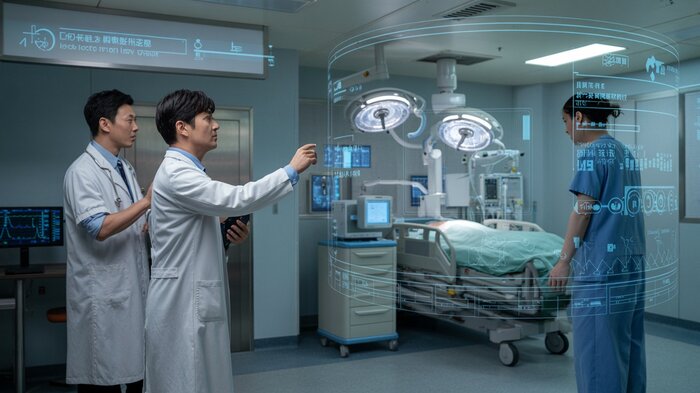
Walk Into a Hospital in China… And You May Never Look at Western Healthcare the Same Way Again
For years, much of the Western world has clung to a simple story about China. We invent, China copies. We lead, China follows. We build the future, China manufactures it cheaply and catches up later.
That story is becoming harder to defend, and nowhere does it fall apart faster than inside some of China's hospitals.
The change is not abstract. It is not buried in a policy paper or hidden in a trade report. It becomes obvious the moment healthcare stops being an argument and becomes a lived experience.
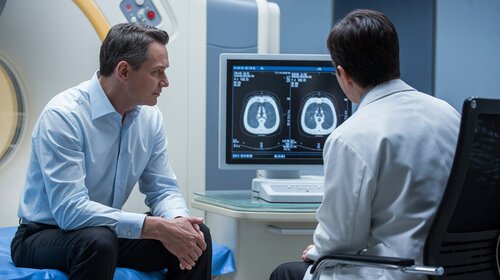
A man in Britain goes for a routine check. During the appointment, a nurse spots something worrying, an ascending aortic aneurysm near his heart. What follows is painfully familiar to millions of people in the UK and across Europe: waiting, uncertainty, more waiting, and then more uncertainty. Months pass before he can properly speak to a doctor. More months pass before he can get a CT scan. Time drifts by while anxiety fills the gaps.
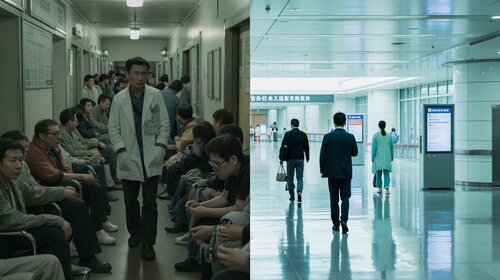
Then the same situation collides with a very different system in China.
He walks into a hospital. He gets registered. He is booked for a scan. The scan is done. The results come back. He sits down with a doctor and talks through what is happening, properly, clearly, in person, on the same day.
This did not happen in some gleaming science-fiction flagship in Shanghai. It happened in one of China's poorer provinces.
That is the detail that makes the story linger. Not the speed on its own, but the location. If this could happen there, what exactly is happening at the top end of the system?
Speed Is Not Cosmetic, It Changes Everything
In the West, healthcare is increasingly experienced as delay. Delay for appointments, delay for scans, delay for referrals, delay for answers. People do not merely suffer from illness. They suffer from waiting to discover how ill they are, waiting to discover whether treatment is urgent, waiting to discover whether the system still has room for them.
In parts of China, especially in the country's major urban centers, the tempo feels completely different. You do not move through a maze of disconnected departments and paper-heavy bottlenecks. You move through a system that has been designed for throughput, coordination, and response.
That difference matters more than many policymakers seem willing to admit. Speed in healthcare is not a luxury. It is not a branding exercise. It is often the difference between reassurance and months of dread, between early action and delayed intervention, between confidence and helplessness.
Western critics can dismiss shiny lobbies and beautiful buildings as superficial, and sometimes they are right to do so. Marble floors do not treat disease. Good lighting does not save lives. But when speed, access, diagnostics, and clinician contact all arrive together, the experience stops being cosmetic. It becomes structural.
What Strikes You First Is Not Ideology, It Is Competence
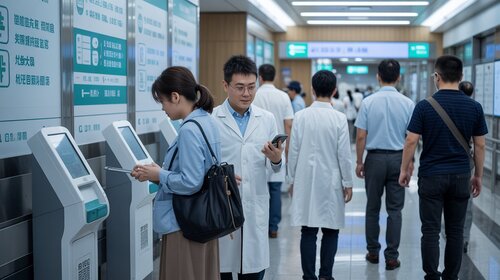
Walk into a modern Chinese hospital and the first impression is often not political at all. It is operational. The place feels as if somebody asked a basic question that too many Western systems seem unable to answer: what if healthcare were organized to function smoothly?
Registration is fast. Payments are integrated. Results appear on phones. Systems talk to each other. Departments feel linked rather than scattered. The patient is moved along rather than left sitting in administrative fog.
What disappears is the friction. Fewer forms. Fewer dead ends. Fewer invisible barriers between patient and treatment.
That is one reason the old stereotype of China as clumsy, backward, or permanently second-rate now sounds absurd to anyone who has actually seen one of these facilities with their own eyes. The surprise is not just that parts of China are modern. The surprise is that they can feel more modern than what many people in Britain, Europe, or even the United States experience at home.
The Old Line, “We Invent, China Copies,” No Longer Works
There was a period when that phrase carried at least some explanatory power. It does not any longer. China is not merely absorbing other people's medical technology and reproducing it at scale. It is now creating medical technology, integrating medical technology, and in some areas pushing healthcare toward forms of delivery that many Western systems are still only discussing.
The important shift is not simply that China manufactures more equipment. It is that China is increasingly inventing, refining, and deploying systems that change how medicine is practiced.
- Artificial intelligence is being used to summarize complex medical records, support diagnostics, monitor patients continuously, and assist clinical decision-making.
- Smart hospital systems are reducing administrative drag.
- Virtual and immersive tools are being used in medical training.
- Large-scale digitization is allowing hospitals to function as connected environments instead of disconnected silos.
This is not the old copycat model. This is a country building healthcare architecture for the next era.
That does not mean every claim made about Chinese innovation should be accepted uncritically. It does mean that anyone still repeating the old slogan is now describing a world that is disappearing beneath their feet.
The West Still Has Strengths, but It Is Losing the Monopoly on Awe
None of this requires fantasy. The best Western systems still retain enormous strengths. Elite specialist expertise remains formidable. Research ecosystems in the United States and Europe remain exceptionally deep. Regulation, standard-setting, and certain outcome measures still matter greatly, and in many domains the West remains world-class.
But what has changed is this: the West no longer holds a monopoly on the idea of what advanced healthcare looks like.
That monopoly has been broken by lived reality.
People who walk into the right hospitals in China are not looking at some rough approximation of modernity. They are not looking at a country trying hard to imitate the real thing. They are looking at a system that, in important ways, has moved beyond the experience millions of Western patients know too well.
That is what makes the reaction so visceral. It is one thing to hear that China has made progress. It is another to stand there, watch the system work, and realize that the gap may no longer be where you were told it was.
What China Seems to Understand
The deeper lesson may be less about any single machine, building, or app. It may be about mentality.
China increasingly seems to understand that invention on its own is not enough. A brilliant medical breakthrough that remains trapped in journals, trials, committees, and bureaucratic hesitation changes very little for the average patient. Technology matters, but implementation matters just as much. Integration matters. Scale matters. Usability matters. Speed matters.
That is where China is becoming harder to ignore. It is not merely generating tools. It is placing those tools into functioning systems and getting them into the hands of clinicians and patients at speed.
In medicine, that is where theory becomes civilization.

Not Perfection, Momentum
To say all this is not to pretend that China has solved every healthcare problem. It has not. Quality varies. Regional disparities remain. No serious observer should describe the entire system as uniformly excellent. That would be propaganda, not journalism.
But an honest article does not need propaganda. The truth is strong enough.
What China shows today is not perfection but momentum, and momentum can be more revealing than any static ranking. A country that improves fast enough eventually forces the world to update its assumptions. A country that combines invention with execution forces even its critics to pay attention.
That is where China now sits. Not as a backward caricature. Not as a futuristic myth. But as a real, fast-moving force in modern healthcare, one that is beginning to make parts of the West look older, slower, and more complacent than they imagined.
The View From Inside the Building
Perhaps that is why the image of a Chinese hospital stays with people. Not because it looks impressive, though some of them do. Not because it flatters anyone's politics. But because it quietly unsettles a worldview.
You walk in expecting to see a system that trails behind. You walk out wondering whether the future arrived there first.
And once that thought has taken hold, it becomes very difficult to go back to the old story.
China is no longer simply copying the future. In medicine and healthcare, it is increasingly inventing parts of it, building parts of it, and showing the world what it looks like when those inventions are actually put to work.
That is why so many Western assumptions now look tired. They were built for an earlier China. The China inside some of these hospitals is something else entirely.
It is faster. It is more integrated. It is more ambitious. And for anyone lucky enough to see it in real life, it can leave them standing there, mouth open, wondering how much else they have been taught to misunderstand.
About the Author
Scott Oliver, 66, is living well with prostate cancer after dedicating more than 4,000 hours to researching the condition. His first goal is to help men reduce their risk of developing prostate cancer through proven lifestyle strategies.
When diagnosed, his mission is to help men avoid unnecessary prostate surgeries that can lead to devastating complications such as incontinence, bleeding, permanent impotence, and a loss of length.
Scott Oliver is not a doctor and does not offer medical advice; however, he is healthier and fitter than he has been in decades. Through his articles and videos, he shares hard-to-find, uncensored information on proven alternative therapies, effective fitness methods, and repurposed drugs, content that most doctors won’t mention and search engines suppress.
He is an accredited member of the National Writers Union (NWU) and the International Federation of Journalists (IFJ), the world’s largest organization of professional journalists. Scott is also the author of What If Cancer’s Best Defense Is Free? Sleep as a Defense Against Cancer: A Former Royal Marines Commando’s 4,000-Hour Research Roadmap, where he reveals how sleep repairs DNA, restores immunity, and strengthens the body’s natural defenses against cancer.
You can always contact Scott Oliver here with your questions and suggestions.