A Parasite Drug Is Being Studied for Cancer, Here’s Why
A plain-English look at mebendazole, cancer resistance, and why researchers are paying attention.
Mebendazole is best known as a low-cost anti-parasite drug.
For decades, it has been used to treat worm infections. But in recent years, cancer researchers have been asking a different question:
Could this old parasite drug also interfere with some of the survival tricks cancer cells use?
A 2025 review paper in Frontiers in Pharmacology looked closely at this question. The paper does not claim that mebendazole is a proven cancer cure. It does something more useful. It explains why researchers are interested in mebendazole as a possible cancer drug-repurposing candidate.
Why Drug Resistance Matters
One of the biggest problems in cancer treatment is drug resistance.
At first, a treatment may work. Then cancer cells adapt. They may pump drugs out, repair damage, avoid cell death, build new blood supply, change their metabolism, or hide from the immune system.
This is why researchers are interested in drugs that may affect more than one cancer pathway at the same time.
Why Mebendazole Is Getting Attention
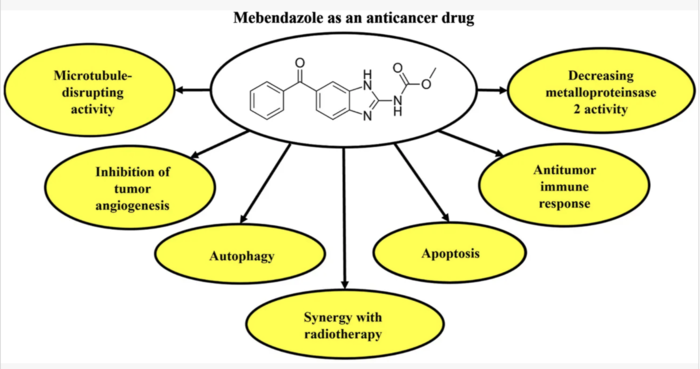
The review explains that mebendazole may affect several cancer-related mechanisms, including:
- Disrupting microtubules, the internal scaffolding cancer cells need to divide.
- Interfering with tumor blood-vessel growth, known as angiogenesis.
- Encouraging damaged cancer cells to undergo programmed cell death, called apoptosis.
- Influencing autophagy, the cell's internal recycling system.
- Modulating immune activity in ways that may support anti-tumor responses.
- Reducing activity of MMP-2, an enzyme linked with invasion and spread.
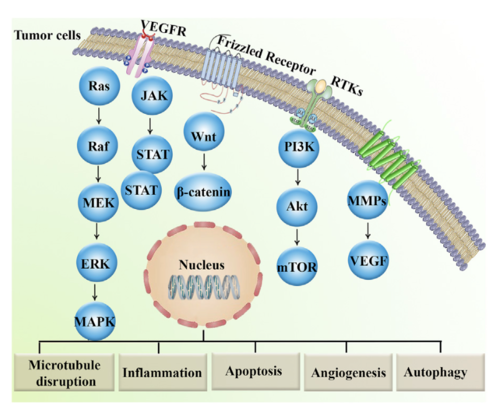
- Affecting signaling pathways involved in cancer growth and treatment resistance.
In simple terms, mebendazole appears interesting because it may not be a one-target drug. It may interfere with several systems cancer cells use to survive.
The Microtubule Connection
Cancer cells divide quickly. To divide, they need a structure inside the cell called microtubules.
Think of microtubules like internal railway tracks. They help move parts of the cell around during division. If those tracks are disrupted, the cancer cell may get stuck and fail to divide properly.
Some chemotherapy drugs already target microtubules. The interesting question is whether mebendazole can do something similar with a different safety and cost profile.
Blood Supply: Cutting Off the Tumor's Support System
Tumors need blood vessels to bring oxygen and nutrients. This process is called angiogenesis.
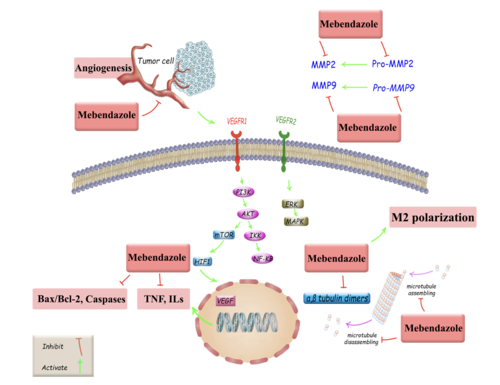
The review discusses evidence that mebendazole may interfere with VEGF and VEGFR signaling, one of the key systems tumors use to build their blood supply.
This matters because blocking blood-vessel growth can make it harder for tumors to expand.
Helping Cancer Cells Die When They Should
Healthy cells are supposed to die when they are badly damaged. Cancer cells often escape this process.
This built-in self-destruction system is called apoptosis.
The review explains that mebendazole may influence proteins involved in apoptosis, including Bcl-2, Bax, p53, XIAP, and caspases. These proteins help decide whether a damaged cell survives or dies.
For cancer researchers, that is important. A drug that helps restore the death signal in cancer cells may make those cells less able to resist treatment.

What Types of Cancer Were Discussed?
The paper reviewed preclinical evidence involving several cancers, including breast cancer, colon cancer, gastric cancer, lung cancer, glioma, medulloblastoma, melanoma, and ovarian cancer.
Most of this evidence comes from laboratory studies and animal studies. That matters.
Cells in a dish are not the same as a man sitting in a doctor's office with prostate cancer. Animal studies are not the same as properly controlled human trials.
This is why the correct conclusion is not, “Mebendazole cures cancer.”
The correct conclusion is, “Mebendazole has enough interesting biological activity that researchers are studying it more seriously.”
After a diagnosis, many men feel flooded with information, opinions, studies, warnings, and pressure from every direction.
If you want to slow things down and get your thinking back on track, you are welcome to send me a private message.
The Big Practical Problem: Absorption
One of the most important points in the paper is not glamorous, but it is critical.
Mebendazole has poor solubility and limited bioavailability.
In plain English, that means the body may not absorb it reliably or deliver enough of it to the tumor site.
This is why researchers are studying improved delivery systems, including nanoparticles, lipid formulations, micelles, nanosuspensions, and other drug-delivery technologies.
For any man reading about mebendazole online, this point is essential. What works in a lab dish at a certain concentration may not happen inside the human body after swallowing a tablet.

What About Human Trials?
The review discusses early clinical research, especially involving high-grade gliomas and advanced gastrointestinal cancers.
Some studies suggest mebendazole may have a favorable safety profile in these settings, including when combined with standard treatment. But this is still early-stage clinical evidence.
There is not yet enough proof to say mebendazole should be considered a standard cancer treatment.
The Warrior Bottom Line
Mebendazole is not magic. It is not a proven cancer cure. And no man should confuse laboratory promise with clinical proof.
But it is also not ridiculous that researchers are studying it.
The reason is simple: mebendazole may affect several cancer-survival systems at once, including cell division, blood-vessel growth, cell death, immune signaling, and drug resistance pathways.
That makes it a serious drug-repurposing candidate worthy of further research.
For men dealing with prostate cancer or any other cancer, the intelligent position is calm curiosity, not blind belief and not automatic dismissal.
If you are considering mebendazole, discuss it with a knowledgeable doctor, especially if you are already taking cancer drugs, blood thinners, liver-stressing medications, or other therapies.
The real goal is not to chase every online claim.
The real goal is to think clearly, ask better questions, understand the evidence, and make decisions that protect your life, your body, and your future.
About the Author
Scott Oliver, 66, is living well with prostate cancer after dedicating more than 4,000 hours to researching the condition. His first goal is to help men reduce their risk of developing prostate cancer through proven lifestyle strategies.
When diagnosed, his mission is to help men avoid unnecessary prostate surgeries that can lead to devastating complications such as incontinence, bleeding, permanent impotence, and a loss of length.
Scott Oliver is not a doctor and does not offer medical advice; however, he is healthier and fitter than he has been in decades. Through his articles and videos, he shares hard-to-find, uncensored information on proven alternative therapies, effective fitness methods, and repurposed drugs, content that most doctors won’t mention and search engines suppress.
He is an accredited member of the National Writers Union (NWU) and the International Federation of Journalists (IFJ), the world’s largest organization of professional journalists. Scott is also the author of What If Cancer’s Best Defense Is Free? Sleep as a Defense Against Cancer: A Former Royal Marines Commando’s 4,000-Hour Research Roadmap, where he reveals how sleep repairs DNA, restores immunity, and strengthens the body’s natural defenses against cancer.
You can always contact Scott Oliver here with your questions and suggestions.