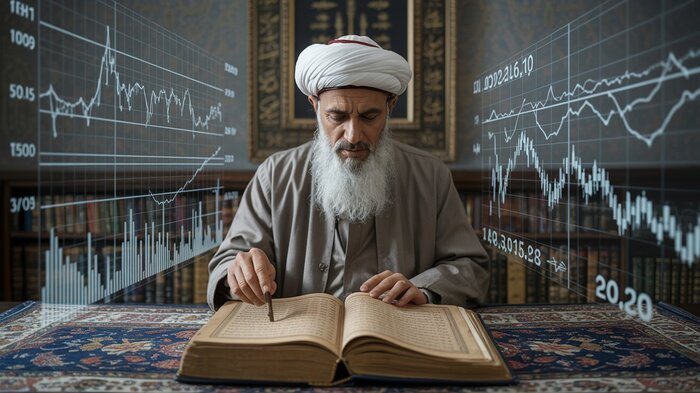
Islamic Finance Was Warning About Financial Speculation Long Before Wall Street Crashed the Global Economy
In 2008, some of the most sophisticated financial institutions on Earth nearly collapsed the global economy using financial products many ordinary people had never even heard of.
- Mortgage-backed securities.
- Credit default swaps.
- Synthetic derivatives.
- Leverage piled upon leverage.
- Risk hidden inside risk.
Yet for centuries, Islamic finance had already warned that excessive speculation, debt expansion, and finance detached from real economic activity could become socially destructive.
At the time, many Western economists dismissed those warnings as outdated religious thinking.
After 2008, they sounded far less irrational.

Most Westerners Think Islamic Finance Simply Means “No Interest”
That is the most common misunderstanding.
Yes, Islamic finance prohibits riba, commonly understood as interest or usury.
But the system is not merely “normal banking without interest.”
It begins from a completely different philosophy of money.
In conventional finance, money itself often becomes a commodity. It can be lent, leveraged, securitized, traded, and multiplied through layers of debt.
In Islamic finance, money is supposed to remain closer to its original purpose.
It is a medium of exchange.
It is a measure of value.
It is not supposed to reproduce itself endlessly without connection to real trade, real assets, real ownership, and real economic activity.
That difference may sound technical.
It is not.
It changes the moral foundation of finance.

Money Was Never Supposed to Become Detached From Reality
Modern finance has become extraordinarily abstract.
A farmer grows food.
A builder constructs a house.
A manufacturer produces useful goods.
Those are real economic activities.
But much of modern finance now operates several layers away from reality.
Contracts are traded on contracts.
Debt is packaged and resold.
Risk is transferred, sliced, insured, leveraged, and hidden.
Financial products become so complex that even the people selling them may not fully understand the consequences when the system begins to crack.
Islamic finance is deeply suspicious of this detachment.
It insists that finance should remain connected to real assets, real trade, real ownership, and real productive activity.
That is one of its most important lessons.
Not because every Islamic financial product is perfect.
But because the underlying warning is powerful: When money becomes too detached from reality, society eventually pays the price.

Speculation Was Viewed as Dangerous Long Before Modern Crashes
Islamic finance does not reject markets.
It does not reject commerce.
It does not reject profit.
But it is highly cautious about excessive uncertainty and gambling-like speculation.
Two key concepts help explain this.
- Gharar refers to excessive uncertainty, ambiguity, or hidden risk in a transaction.
- Maysir refers to gambling or speculation where one party gains mainly because another loses, without productive economic activity behind the transaction.
These ideas are often treated in the West as old religious rules.
But look at modern financial history.
Speculation has repeatedly proven dangerous when combined with leverage, opacity, and greed.
The 1929 crash was fueled partly by margin debt and speculative mania.
Long-Term Capital Management nearly collapsed in 1998 after highly leveraged bets went wrong.
The dot-com bubble destroyed enormous wealth when speculation outran economic reality.
The 2008 global financial crisis revealed how mortgage debt, derivatives, leverage, ratings failures, and hidden counterparty risk could threaten the entire financial system.
More recently, we have seen speculative blowups in crypto, meme stocks, shadow banking, and highly leveraged family offices.
The lesson is not that all speculation is evil.
Some speculation provides liquidity. Some hedging protects real businesses. Some risk-taking is necessary for enterprise.
But highly leveraged, opaque, detached financial speculation has repeatedly proven capable of destabilizing markets, destroying wealth, and forcing ordinary taxpayers to clean up the mess.
Islamic finance did not reject speculation because it opposed markets, it rejected excessive speculation because it feared fragility.
That warning looks wiser today than many people want to admit.

When Financial Engineering Nearly Destroyed the Global Economy
The 2008 crisis should have permanently changed the way the world thinks about finance.
For years, Wall Street had transformed home mortgages into complex securities.
Those securities were sliced into tranches, rated, sold, insured, leveraged, and traded around the world.
Credit default swaps created the appearance of protection, ratings agencies created the appearance of safety, mathematical models created the appearance of control but, beneath the surface, the system had become dangerously fragile.
When U.S. housing prices fell and mortgage defaults rose, the damage spread through banks, insurers, pension funds, investment houses, and governments.
Suddenly, ancient warnings about uncertainty, speculation, and finance detached from real value no longer sounded primitive.
They sounded disturbingly relevant.
The modern financial system had built a tower of confidence on instruments many people did not understand.
When confidence broke, the tower nearly came down.
The Derivatives Problem Few Ordinary People Understand
One of the greatest sources of hidden risk in modern finance is the global derivatives market.
Derivatives are contracts whose value is linked to something else, such as interest rates, currencies, commodities, bonds, stocks, or credit risk.
Used carefully, derivatives can help real businesses manage real risks.
An airline may hedge fuel costs.
An exporter may hedge currency exposure.
A company may hedge interest-rate risk.
But derivatives can also become speculative, highly leveraged, opaque, and dangerous.
According to the Bank for International Settlements, the notional value of outstanding over-the-counter derivatives reached approximately US$846 trillion at the end of June 2025.
That number must be understood carefully.
Notional value is not the same as the amount that would be lost in a crisis.
But it does reveal the extraordinary scale and interconnectedness of modern financial engineering.
Islamic finance generally takes a far more cautious view of conventional derivatives because many involve excessive uncertainty, speculation, leverage, or interest-based structures.
It is not accurate to say every possible risk-management tool is forbidden in every circumstance. Some Sharia-compliant hedging structures exist for legitimate commercial purposes.
But the deeper principle remains clear.
Finance should not become a casino pretending to be a productive economy.

A Civilization Built on Debt Begins to Think Differently
The danger is not only systemic.
It is personal.
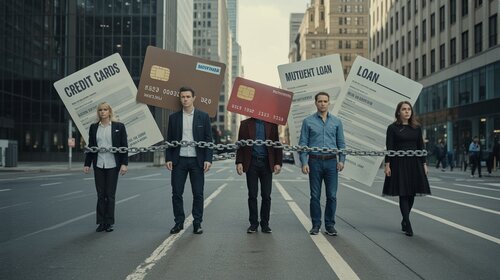
Modern Western life has normalized debt at almost every stage of adulthood.
- Student loans.
- Credit cards.
- Car loans.
- Mortgages.
- Business loans.
- Medical debt.
- Buy-now-pay-later schemes.
- Refinancing.
- Debt consolidation.
Debt becomes so normal that many people no longer experience it as a warning sign.
They experience it as life.
But debt changes psychology.
It makes people more anxious.
It makes workers more obedient.
It makes families more fragile.
It makes young people delay marriage, children, home ownership, business creation, and independence.
It turns future income into collateral for present survival.
Islamic finance emerged from a worldview that viewed excessive debt as morally, socially, and spiritually dangerous.
That does not mean Islamic societies have eliminated debt problems.
They have not.
But the warning itself deserves respect.
A society that normalizes permanent debt may eventually produce people who no longer feel free.

Which People Benefit Most From Each Financial System?
Every financial system distributes rewards, risks, power, and opportunity differently.
The question is not whether one system is perfectly moral and the other completely corrupt.
The more interesting question is this: Who gains the greatest long-term advantage under each model?
Modern interest-based financial systems have undeniably helped fuel enormous economic growth, technological innovation, home ownership, business expansion, and capital formation.
But they also tend to reward certain groups far more than others.
Large financial institutions benefit from recurring interest income, refinancing, leverage, fees, securitization, and financial engineering.
Asset owners often benefit from monetary expansion and rising asset prices.
Sophisticated investors and corporations can use debt strategically to acquire assets, reduce taxes, expand operations, and magnify returns.
Governments benefit from the ability to borrow heavily, expand spending, and defer economic pain into the future.
But the same system can create enormous long-term pressure on ordinary households.
Young people often begin adult life burdened by student debt.
Families may spend decades servicing mortgages.
Credit cards normalize revolving debt.
Car loans grow larger and longer.
Entire societies can become dependent on perpetual credit expansion simply to maintain economic momentum.
And when highly leveraged systems break, the damage rarely remains confined to banks.
Taxpayers, workers, pensioners, small businesses, and savers often absorb the consequences.
Islamic finance attempts to distribute some of these incentives differently.
In theory, risk should be shared more broadly.
Finance should remain connected to real economic activity.
Speculation should be restrained before it becomes socially destructive.
Debt should not become the organizing principle of civilization itself.
This does not mean Islamic finance eliminates greed, inequality, corruption, or political abuse.
It does not.
Wealthy elites, cronyism, and financial misconduct still exist throughout parts of the Muslim world, just as they exist everywhere else.
But the underlying philosophical question remains fascinating.
- Modern Western finance often asks: How can capital maximize return?
- Islamic finance traditionally asks: What kind of financial behavior creates a stable, ethical, and socially healthy society?
That is not merely a banking question, it is a civilizational question.
The More Financialized an Economy Becomes, the More Fragile It Can Become
Financialization occurs when an economy becomes increasingly dominated by financial markets, financial motives, financial institutions, and financial engineering.
- Instead of finance serving the real economy, the real economy begins serving finance.
- Companies focus more on stock buybacks than long-term investment.
- Homes become speculative assets instead of places to live.
- Education becomes a debt-financed product.
- Healthcare becomes a billing system.
- Governments become dependent on bond markets.
- Ordinary people become credit profiles.
This is not healthy.
It creates the appearance of wealth while increasing fragility underneath.
Asset prices rise.
Debt expands.
Leverage builds.
Risk migrates into hidden corners of the system.
Then, when something breaks, everyone is shocked by how connected the damage becomes.
This is why the Islamic suspicion of excessive debt and speculation deserves serious attention.
Not because Islamic finance is perfect.
But because it asks questions modern finance often avoids.
- Should money be allowed to make money without productive activity?
- Should risk be transferred entirely onto borrowers?
- Should speculation be treated as harmless innovation?
- Should debt become the foundation of ordinary life?
- Should finance be judged only by profit, or also by the kind of society it produces?

Islamic Finance Is Not Perfect
To be clear, Islamic finance is not a magical solution.
Some Islamic financial products are criticized for looking too much like conventional banking with different legal language.
Some institutions follow the letter of Sharia compliance while critics argue they miss the spirit.
Some Muslim-majority countries still suffer from corruption, inequality, political favoritism, crony capitalism, and elite privilege.
Human greed does not disappear because a financial product has religious approval.
That honesty matters.
The point is not that Islamic finance has solved every problem.
The point is that its foundational questions are far deeper than many Westerners realize.
- It asks whether finance should be morally restrained.
- It asks whether money should remain connected to real value.
- It asks whether speculation can become socially poisonous.
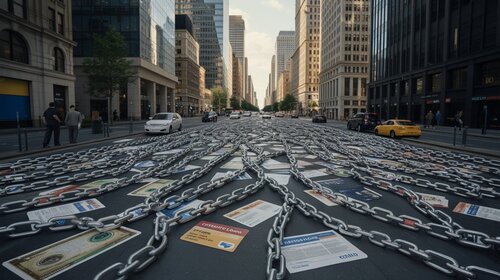
- It asks whether debt can quietly enslave people without chains.
And after the repeated crises of modern finance, those questions no longer seem old-fashioned, they seem urgent.
The Prostate Cancer Warrior's Conclusion
Perhaps civilizations do not collapse all at once.
Perhaps they become progressively more fragile as debt expands, leverage intensifies, and finance drifts further away from real productive life.
Perhaps the warning signs are not always dramatic at first.
- They appear as household stress.
- They appear as unaffordable homes.
- They appear as young people drowning in debt.
- They appear as asset bubbles.
- They appear as bailouts.
- They appear as inflation.
- They appear as entire nations trapped by creditors.
- They appear as economies that cannot survive without more borrowing, more stimulus, more leverage, and more financial manipulation.
Islamic finance was warning about these dangers long before Wall Street crashed the global economy.
Not because every Islamic banker is wise, or because every Sharia-compliant product is pure.
Not because any civilization has fully conquered greed. But because the philosophy itself understood something modern finance keeps trying to forget:
Money should serve life, life should not serve money.
The real question is no longer whether financial speculation can become dangerous.
History has already answered that.
The real question is how much instability a civilization built on perpetual leverage, expanding debt, and detached financial speculation can absorb before the cracks become impossible to hide.
About the Author
Scott Oliver is a British writer and former Royal Marines Commando who has lived abroad since 1985. Over the last 66 years, he’s called twelve countries home, including twenty-five years in Spanish-speaking nations such as Spain, Costa Rica, and Guatemala. He has also lived in Sierra Leone, Ghana, Nigeria, Liberia, Cyprus, the USA, Grand Cayman and now lives in Mauritius.
A warrior by nature, Scott is living with prostate cancer and writing from the front lines. He speaks directly to men about health, masculinity, freedom, and strength, physically, mentally, emotionally, and sexually. His views are proudly independent: he questions conventional medicine, challenges destructive treatments, and tells the truth most men never hear.
Scott Oliver is an officially accredited member of the National Writers Union (NWU) and the International Federation of Journalists (IFJ), the world’s largest organization of professional journalists. He spent ten years on Wall Street and another decade as an offshore wealth manager, specializing in globally diversified, multi-currency hedge fund portfolios. He is the author of What If Cancer’s Best Defense Is Free? — Sleep as a Defense Against Cancer: A Former Royal Marines Commando’s 4,000-Hour Research Roadmap, where he reveals how sleep repairs DNA, restores immunity, and strengthens your fight against cancer. He’s also the author of books on offshore investing and Costa Rica real estate and has written thousands of articles in English and Spanish on living abroad with courage, clarity, and conviction.
You can always contact Scott Oliver here with your questions and suggestions.
Expert Resources Used By Scott Oliver To Research and Write This Article
- LSEG: Islamic Finance Development Report 2025. Reports that global Islamic finance assets reached approximately US$5.98 trillion in 2024 and are projected to reach approximately US$9.7 trillion by 2029. Read the report overview
- Islamic Corporation for the Development of the Private Sector: LSEG and ICD Announce Findings of the 2025 Islamic Finance Development Indicator Report. Summarizes the latest global Islamic finance growth projections. Read the announcement
- World Bank: Global Islamic Finance Development Center. Explains the mainstream institutional view of Islamic finance, including asset-backed finance, ethical investment, and risk-sharing. Read at the World Bank
- Bank for International Settlements: OTC Derivatives Statistics at End-June 2025. Reports that outstanding over-the-counter derivatives reached approximately US$846 trillion in notional value at the end of June 2025. Read the BIS statistics
- Bank for International Settlements: OTC Derivatives Statistics Overview. Explains notional value, gross market value, and credit exposure in derivatives markets. Read the BIS overview
- ScienceDirect: Financial Derivative Instruments and Their Applications in Islamic Finance. Reviews debates around derivatives, hedging, risk management, and Sharia principles. Read the study
- Bursa Malaysia: Islamic Derivatives Products. Provides examples of Islamic derivatives and Sharia-compliant risk-management products in regulated markets. Read the explanation
- Africa Check: Did Gaddafi Plan to Introduce an African Currency Backed by Gold Reserves? Reviews claims about Muammar Gaddafi, gold reserves, and proposals for an African currency. Read the fact check
- Council on Foreign Relations: Venezuela, the Rise and Fall of a Petrostate. Provides background on Venezuela's oil dependency, political crisis, sanctions, and economic collapse. Read the backgrounder
- University of Denver, Korbel School: How Sanctions Contributed to Venezuela's Economic Collapse. Discusses the role sanctions played in worsening Venezuela's economic crisis. Read the analysis
- Self Financial: Life of Interest. Estimates how much interest Americans may pay over a lifetime across mortgages, credit cards, auto loans, student loans, and other debts. Read the analysis
- LendingTree: Average Car Payment and Auto Loan Statistics. Tracks U.S. auto loan balances, monthly payments, and borrowing trends. Read the auto debt statistics
- Experian: Average Monthly Loan Payments. Provides data on average monthly payments for mortgages, auto loans, personal loans, and other consumer debt categories. Read the Experian data