
Why Doctors Insist on Seeing You In-Person Instead of Sending a Simple Email
Few sentences create more immediate anxiety than this one: “The doctor would like to see you in person.”
For many people, those few words immediately change the emotional atmosphere of the day. Concentration becomes difficult. Ordinary tasks suddenly feel strangely unimportant. The mind starts filling in missing information on its own, often imagining possibilities far worse than reality.
By evening, many people find themselves endlessly searching online, trying to interpret a sentence that may have lasted less than ten seconds on the phone.
“If it was nothing serious, they would have just emailed me.”
That assumption is incredibly common. And sometimes it is correct. But what most people never stop to ask is a far more interesting question: why are doctors often so reluctant to simply explain things clearly in writing?
After all, we live in a world where people buy homes online, move money electronically, sign legal contracts digitally, and run global companies remotely from smartphones. Yet in modern medicine, many patients are still told they must physically travel to a clinic, sit in a waiting room, and miss half a day of work just to hear a five-minute explanation that could theoretically fit into a short email.
To many patients, the system feels strange, inefficient, and emotionally cruel. But the real explanation is more complicated than most people realize.

The Assumption Most Patients Make
When patients are told to “come in,” many immediately begin constructing explanations in their minds. Some assume the doctor is trying to generate another billable appointment. Others assume the news must be devastating. Some believe doctors intentionally withhold information to maintain authority or control over frightened patients.
And in fairness, there are situations where financial incentives absolutely influence medical behavior. Modern healthcare systems are businesses as much as they are caregiving systems. But reducing the entire issue to greed oversimplifies something much larger.
Because modern medicine is not simply organized around communication. It is organized around liability.
Medicine Is Not Just About Information. It Is About Legal Exposure.
Most patients think the doctor's job is simply to diagnose illness and recommend treatment. Legally speaking, however, physicians are also expected to document communication carefully, explain risks and alternatives, confirm patient understanding, discuss possible complications, protect confidentiality, and create defensible medical records.
That changes everything.
A short email may seem efficient to the patient. But to a physician, that same email can represent uncertainty, ambiguity, and potential legal vulnerability.
If a patient later claims, “I did not understand the seriousness,” “I was never properly informed,” “I misunderstood the risks,” or “No one explained the alternatives,” the physician may now face a legal and professional problem.
An in-person appointment creates something medicine values enormously: documentation.
The chart can now reflect that findings were explained, treatment options were discussed, risks and side effects were reviewed, questions were answered, and the patient appeared to understand the conversation.
In modern medicine, documentation is protection. And many doctors increasingly practice medicine inside systems shaped heavily by malpractice fear.

Many Patients Dramatically Underestimate the Emotional Impact of Medical News
There is another reality most people do not fully appreciate until they personally experience a serious diagnosis. Fear changes cognition.
A frightened human being often processes information differently than a calm one. People hear selectively. They forget large portions of conversations. They catastrophize statistics. They misinterpret medical terminology. They sometimes walk out of consultations remembering only the single sentence that frightened them most.
This is particularly true in areas like cancer medicine.
The moment people hear words like “tumor,” “biopsy,” or “malignancy,” the nervous system frequently shifts into a state of threat detection.
Doctors are trained to anticipate this. Not because physicians are necessarily emotionally fragile or deeply “worried” about every patient, but because medicine has learned through experience that emotionally overwhelmed patients often misunderstand important information.
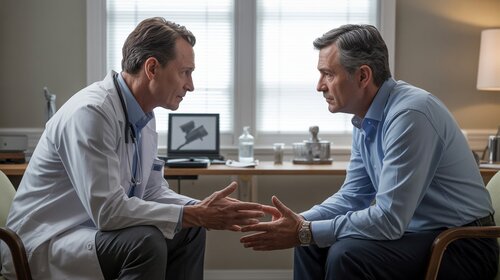
An in-person meeting allows doctors to observe emotional reactions, clarify misunderstandings immediately, answer questions in real time, assess psychological stability, and reduce the risk of confusion or panic.
Whether physicians always do this well is another question entirely. But that is part of the logic behind the system.
Many men reach a point where the information about prostate cancer becomes seriously overwhelming. Different opinions. Different options. No clear path forward.
If you would like to step back and think clearly before making any decisions, you are welcome to contact me. I will read your situation personally and respond thoughtfully.
No pressure. No sales pitch. Just a calm, focused exchange to help you see things clearly.
The Financial Incentive Nobody Likes Discussing
There is also an uncomfortable economic reality sitting quietly underneath modern healthcare.
In many countries, doctors are reimbursed for appointments. They are often not reimbursed for lengthy email exchanges.
That distinction matters enormously.
A physician may already be carrying administrative overload, insurance paperwork, regulatory compliance tasks, documentation demands, hospital reporting requirements, and dozens of patient messages per day.
Long thoughtful email communication can quickly become unpaid labor inside an already overloaded system.
So healthcare evolved around billable visits rather than detailed digital correspondence.
This does not automatically mean individual doctors are greedy. It means the system itself was financially designed around appointments.

Defensive Medicine Changed the Psychology of Modern Healthcare
There was a time when medicine operated more informally. Doctors made house calls. Physicians knew families personally. Conversations were often direct and human.
Modern healthcare is very different.
Today's medical systems are increasingly bureaucratic, protocol-driven, standardized, and legally defensive.
Many physicians now practice medicine with one eye on the patient and one eye on the lawsuit.
That may sound cynical. But for many doctors, it is simply reality.
A single communication failure can become a complaint to a medical board, a malpractice lawsuit, a hospital disciplinary issue, an insurance problem, or a reputational threat.
So doctors learn to protect themselves through process. They use formal consultations, careful wording, written notes, standard consent forms, documented follow-ups, and institutional protocols.
Sometimes this protects the patient. Sometimes it protects the doctor. Often, it protects the institution.

The Digital Contradiction
This is where the whole thing begins to feel absurd to many modern patients.
We can file taxes online. We can sign mortgage documents electronically. We can transfer large sums of money through secure banking systems. We can consult attorneys by video call. We can run companies across continents without ever entering the same room.
Yet a patient may still be told to attend an in-person appointment just to hear, “Your PSA has gone up slightly,” or “Your scan needs further review,” or “The results were not exactly what we hoped.”
That contradiction is real.
Some of it is justified by medical complexity. Some of it is caused by outdated systems. Some of it is driven by liability. Some of it is financial. Some of it is simply habit.
Medicine has adopted extraordinary technology inside the body, but it has often remained strangely old-fashioned in the way it communicates with the human being attached to that body.
Sometimes the In-Person Visit Really Is Appropriate
None of this means every in-person appointment is unnecessary.
There are many situations where a face-to-face conversation is clearly appropriate, especially when the information is serious, complex, emotionally difficult, or likely to require careful decision-making.
A cancer diagnosis should not be tossed into someone's inbox like a bank statement. A major treatment decision should not be reduced to a few hurried sentences typed between other appointments. A discussion involving surgery, radiation, hormone therapy, side effects, recurrence risk, or long-term quality of life deserves time, context, and questions.
The problem is not that doctors sometimes want to see patients in person.
The problem is that medical systems often fail to explain why.
That silence creates fear.

Patients Can Tolerate Difficult Truths Better Than Uncertainty
Most patients are not children. They do not need to be protected from every uncomfortable fact. What they need is clarity, respect, and timely communication.
A simple message saying, “There is no emergency, but your doctor would like to discuss the result carefully with you,” can dramatically reduce fear.
So can a message saying, “Your result requires explanation, but this is not something you need to panic about tonight.”
Those few words can spare someone hours or days of unnecessary psychological suffering.
Patients can tolerate difficult truths far better than prolonged uncertainty.
What many people experience as “bad communication” is not always cruelty. Sometimes it is bureaucracy. Sometimes it is legal caution. Sometimes it is a broken workflow. Sometimes it is a doctor trying to manage too many patients in too little time.
But the emotional impact on the patient is still real.
The Real Issue Is Not Email Versus In-Person Care
The real issue is not whether doctors should send everything by email or force every discussion into an office visit.
The real issue is whether patients are treated as intelligent adults who deserve timely, humane, and understandable communication.
There are times when an email is enough. There are times when a phone call is enough. There are times when a video consultation would be perfectly reasonable. And there are times when an in-person appointment is absolutely the right choice.
But what should never happen is leaving a frightened patient suspended in silence, imagining the worst, simply because the system has not learned how to communicate like a human being.
Final Thought
When your doctor insists on seeing you in person, it does not automatically mean disaster. It may mean the issue is serious. It may mean the explanation is complex. It may mean the doctor wants to document the conversation properly. It may mean the clinic has rigid rules. It may mean the system is protecting itself.
But it also reveals something important about modern medicine.
Healthcare has become highly advanced, yet often emotionally primitive. It can scan the body in astonishing detail, operate with robotic precision, and measure biological markers with extraordinary accuracy.
But it still frequently struggles to do one very simple human thing well: communicate clearly before fear takes over.
Sometimes what patients fear most is not the diagnosis itself. It is the silence before the explanation.
About the Author
Scott Oliver, 66, is living well with prostate cancer after dedicating more than 4,000 hours to researching the condition. His first goal is to help men reduce their risk of developing prostate cancer through proven lifestyle strategies.
When diagnosed, his mission is to help men avoid unnecessary prostate surgeries that can lead to devastating complications such as incontinence, bleeding, permanent impotence, and a loss of length.
Scott Oliver is not a doctor and does not offer medical advice; however, he is healthier and fitter than he has been in decades. Through his articles and videos, he shares hard-to-find, uncensored information on proven alternative therapies, effective fitness methods, and repurposed drugs, content that most doctors won’t mention and search engines suppress.
He is an accredited member of the National Writers Union (NWU) and the International Federation of Journalists (IFJ), the world’s largest organization of professional journalists. Scott is also the author of What If Cancer’s Best Defense Is Free? Sleep as a Defense Against Cancer: A Former Royal Marines Commando’s 4,000-Hour Research Roadmap, where he reveals how sleep repairs DNA, restores immunity, and strengthens the body’s natural defenses against cancer.
You can always contact Scott Oliver here with your questions and suggestions.