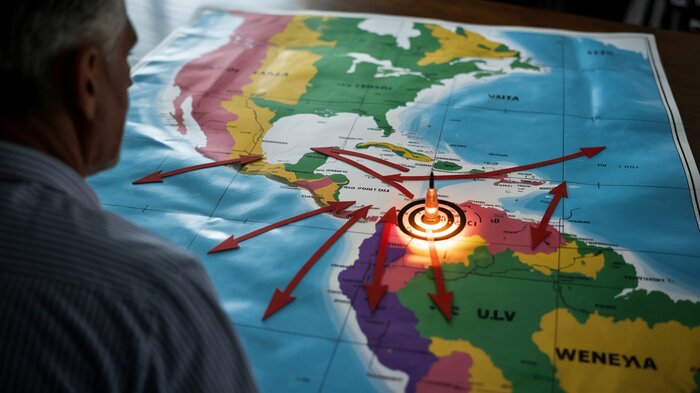
Why Did It Take the U.S. Fifty-Four Years to Start Seriously Waging the War on Drugs?
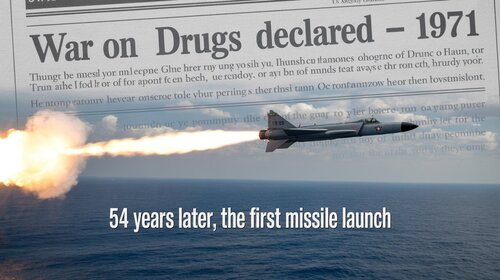
It took fifty-four years for the United States to start firing missiles in the War on Drugs, half a century of speeches, arrests, and failed policies before Washington decided to treat it like a literal war.
But instead of targeting the true sources of America's drug problem, those missiles are falling near Venezuela, a country that isn't even among the top five producers or exporters of narcotics to the U.S.
We now know, with a clarity the Nixon era could never have imagined, where most of the drugs flooding American streets actually come from. Yet Washington has chosen to open a new front in the southern Caribbean, a move that has baffled regional observers and alarmed legal experts.
What the Evidence Really Shows
Colombia remains the principal origin of the cocaine that reaches the United States. Forensic analysis of seized samples consistently points back to Colombian coca leaf and Colombian production methods. That is not a minor footnote; it is the geography of the cocaine trade itself.
Treating Venezuela as the fulcrum of U.S. anti-narcotics strategy is like bombing the wrong factory and then wondering why supply lines keep flowing.
When it comes to heroin and the vast flow of illicit fentanyl entering the United States, Mexico looms largest. Mexican criminal organisations control production, trafficking routes, and cross-border distribution networks that move drugs north in overwhelming quantities.
Central American nations such as Guatemala, Honduras, and Costa Rica play vital roles as transit corridors. They are staging grounds, not producers, but their geography links Colombia's output directly to Mexico's networks, and ultimately to U.S. consumers.

Bombs in the Wrong Place
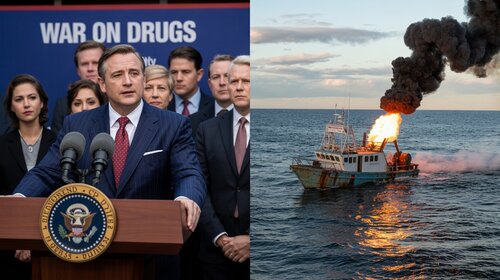
In recent weeks the United States has carried out multiple missile and air strikes on small vessels near Venezuelan waters, an unprecedented escalation in the modern history of American counter-narcotics operations. The strikes have drawn outrage across the region and raised serious questions about legality and intent.
What makes these actions truly extraordinary is how irrelevant they are to America's drug problem. According to international drug-flow data, less than one percent of the narcotics that reach U.S. streets originate or transit through Venezuela.
By contrast, the overwhelming majority come from Colombia and Mexico, moving north through Central American corridors that include Honduras, Guatemala, and Costa Rica. In other words, the missiles are falling where the drugs are not.
To call this “fighting the War on Drugs” is disingenuous. It's like bombing Iceland to stop Mexican cartels, a display of force aimed at the wrong map.
United Nations experts and neighbouring governments have questioned the strikes' legality and warned that such tactics risk civilian lives, diplomatic fallout, and a dangerous precedent for the future use of force in the region.
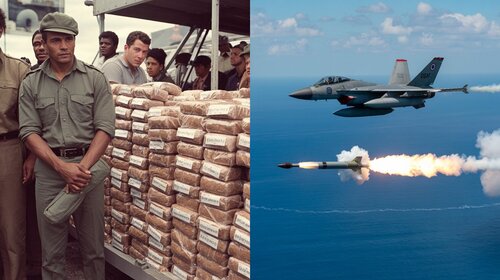
There are three plain problems with this new approach.
- First, missile strikes at sea target symptoms, not sources. They do nothing to disrupt the land-based networks where drugs are cultivated, processed, and sold.
- Second, lethal force risks killing non-combatants, inflaming regional tensions, and encouraging traffickers to diversify routes rather than abandon them.
- Third, focusing political energy on a country that contributes almost nothing to U.S. drug inflows is less a counter-narcotics policy than geopolitical theatre.
The Real Agenda
Bombing at sea may produce dramatic headlines, but it will not fix the maps that show where the problem begins. The War on Drugs has always been theatre, a performance designed to project control rather than achieve it.
After fifty-four years, genuine results would require a radically different playbook from day one. What we are witnessing now looks less like a campaign against narcotics and more like a calculated move for strategic leverage, and Venezuela's oil lies squarely in that crosshair.
If policymakers truly wanted fewer drugs on American streets, they would have followed the data, not the politics. Instead, they followed a script, and it ends with missiles.
About the Author
Scott Oliver is a British writer and former Royal Marines Commando who has lived abroad since 1985. Over the last 66 years, he’s called twelve countries home, including twenty-five years in Spanish-speaking nations such as Spain, Costa Rica, and Guatemala. He has also lived in Sierra Leone, Ghana, Nigeria, Liberia, Cyprus, the USA, Grand Cayman and now lives in Mauritius.
A warrior by nature, Scott is living with prostate cancer and writing from the front lines. He speaks directly to men about health, masculinity, freedom, and strength, physically, mentally, emotionally, and sexually. His views are proudly independent: he questions conventional medicine, challenges destructive treatments, and tells the truth most men never hear.
Scott Oliver is an officially accredited member of the National Writers Union (NWU) and the International Federation of Journalists (IFJ), the world’s largest organization of professional journalists. He spent ten years on Wall Street and another decade as an offshore wealth manager, specializing in globally diversified, multi-currency hedge fund portfolios. He is the author of What If Cancer’s Best Defense Is Free? — Sleep as a Defense Against Cancer: A Former Royal Marines Commando’s 4,000-Hour Research Roadmap, where he reveals how sleep repairs DNA, restores immunity, and strengthens your fight against cancer. He’s also the author of books on offshore investing and Costa Rica real estate and has written thousands of articles in English and Spanish on living abroad with courage, clarity, and conviction.
You can always contact Scott Oliver here with your questions and suggestions.