
At What Age Should Black Men Start Prostate Cancer Screening? The question that can quietly shape your future
Most men do not think about prostate cancer in their forties.
They feel strong. They feel healthy. Life is busy. Work, family, responsibilities. The idea of cancer feels like something for later.
But for Black men, “later” can sometimes come too late.
That is why this question matters more than most men realize:
At what age should you actually start paying attention?

The Short Answer Most Men Never Hear Clearly
For Black men, most experts now agree that the conversation about prostate cancer screening should begin earlier than it does for the general population.
Not at 55.
Not when symptoms appear.
But often between the ages of 40 and 45.
This does not mean rushing into treatment. It does not mean panic. It means starting the conversation early enough to stay in control.
The goal is simple: know where you stand before something silent has time to grow.
Why Earlier Matters More for Black Men
Black men face a higher risk of developing prostate cancer and a higher risk of dying from it.
They are also more likely to develop prostate cancer at a younger age.
This does not mean every Black man will develop aggressive disease. But it does mean the margin for waiting is smaller.
In practical terms, that means:
Starting the conversation earlier gives you more time to detect changes early, understand your baseline, and make calm, informed decisions instead of rushed ones.
Because prostate cancer, in its early stages, usually does not cause symptoms.
That is what makes it dangerous.
The Most Dangerous Mistake: Waiting for Symptoms
Many men believe they will “feel something” if there is a problem.
This is one of the biggest misunderstandings in prostate health.
Early prostate cancer often produces no warning signs at all.
No pain.
No urinary issues.
No obvious signal that anything is wrong.
By the time symptoms appear, the disease may already be more advanced.
For Black men, who already face a higher risk of aggressive disease, waiting for symptoms is not a smart strategy.
It is a gamble.
What “Starting Screening” Actually Means
Screening does not mean jumping into biopsies or treatment.
It starts with something much simpler.
A conversation.
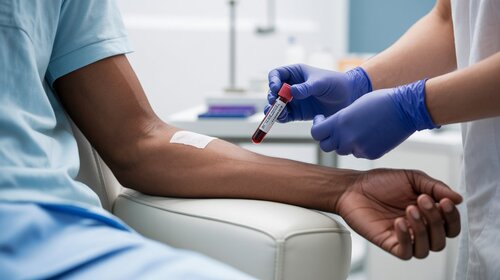
Usually followed by a basic blood test called PSA, or prostate-specific antigen.
This is important to understand clearly.
The PSA test is not a cancer test. It is a signal.
It measures a protein produced by the prostate. Levels can rise for many reasons, including normal aging, inflammation, or enlargement of the prostate.
That is why one number on its own does not tell the full story.
What matters more is:
How your PSA changes over time.
Your age.
Your family history.
And whether further investigation is needed.
This is how smart screening works.

Why a Baseline in Your Forties Is So Valuable
One of the most overlooked advantages of starting early is establishing a baseline.
A PSA test taken at age 42 or 45 gives you a reference point.
It tells you what “normal” looks like for your body.
From there, doctors can track changes over time.
This is far more powerful than reacting to a single high number later in life with no context.
A rising trend matters more than a single reading.
And trends take time to see.
That is why starting earlier creates a strategic advantage.
What If You Have a Family History?
If your father, brother, or close relative had prostate cancer, the conversation should start even earlier.
Family history increases risk. When combined with Black ancestry, the risk can be higher still.
In these cases, many clinicians recommend beginning discussions closer to age 40.
Again, this is not about fear. It is about awareness.
Knowing your risk allows you to act calmly, not react under pressure.

The Real Goal Is Not Early Treatment
This is where many men get confused.
Starting screening earlier does not mean starting treatment earlier.
Those are two very different things.
Many prostate cancers grow slowly and may never require immediate treatment.
Some men can be safely monitored through a process called active surveillance, where the cancer is carefully tracked over time.
The purpose of early screening is not to rush into surgery or radiation.
The purpose is to identify dangerous cancers early while avoiding unnecessary treatment for low-risk disease.
That balance is where smart decision-making lives.
If you are being asked to make a decision about surgery, radiation, medication, or another major treatment, it can help to step back before you move forward.
I can help you think through the questions you may want to ask, the risks you may want to understand, and the next step that feels right for you.
A Smarter Way to Think About It
Instead of asking, “When do I need treatment?” a better question is: “When do I need information?”
For Black men, that answer is often earlier than expected.
Because once you have information, you have options.
And once you have options, you have control.
What You Can Do Next
If you are a Black man in your forties, or approaching them, this is the time to act.
Not aggressively. Not emotionally. But intelligently.
Start the conversation with a doctor you trust.
Ask about a baseline PSA test.
Learn your family history.
Track your numbers over time.
And if something does not feel right, or does not make sense, ask questions or get a second opinion.
You do not need to rush.
But you do need to know.
Conclusion: Earlier Awareness, Better Outcomes
For Black men, prostate cancer is a more serious risk. But it is also a risk that can often be managed far more effectively when addressed early.
Starting the screening conversation between ages 40 and 45 is not about fear.
It is about staying ahead of something that often moves silently.
The men who do best are not the ones who panic.
They are the ones who understand their risk, gather information early, and make decisions from a position of strength.
That is the real advantage of starting sooner.
Not just detection.
Control.
About the Author
Scott Oliver, 66, is living well with prostate cancer after dedicating more than 4,000 hours to researching the condition. His first goal is to help men reduce their risk of developing prostate cancer through proven lifestyle strategies.
When diagnosed, his mission is to help men avoid unnecessary prostate surgeries that can lead to devastating complications such as incontinence, bleeding, permanent impotence, and a loss of length.
Scott Oliver is not a doctor and does not offer medical advice; however, he is healthier and fitter than he has been in decades. Through his articles and videos, he shares hard-to-find, uncensored information on proven alternative therapies, effective fitness methods, and repurposed drugs, content that most doctors won’t mention and search engines suppress.
He is an accredited member of the National Writers Union (NWU) and the International Federation of Journalists (IFJ), the world’s largest organization of professional journalists. Scott is also the author of What If Cancer’s Best Defense Is Free? Sleep as a Defense Against Cancer: A Former Royal Marines Commando’s 4,000-Hour Research Roadmap, where he reveals how sleep repairs DNA, restores immunity, and strengthens the body’s natural defenses against cancer.
You can always contact Scott Oliver here with your questions and suggestions.
Relevant Expert Resources
- American Urological Association: Early Detection of Prostate Cancer Guideline
Clinical guideline recommending earlier screening discussions for higher-risk groups, including Black men and those with family history.
Read the guideline - American Cancer Society: Prostate Cancer Early Detection
Clear overview of when men should begin screening discussions based on risk level, including earlier conversations for Black men.
Read at the American Cancer Society - National Cancer Institute: Prostate Cancer Screening Overview
Balanced explanation of PSA testing, benefits, risks, and decision-making for early detection.
Read at the National Cancer Institute - Memorial Sloan Kettering Cancer Center: Prostate Cancer Screening Guidelines
Practical, patient-friendly guidance on screening strategies, including individualized risk-based approaches.
Read at MSKCC - ZERO Prostate Cancer: Black Men and Screening
Focused resource explaining why Black men should consider earlier screening and how to take action.
Read at ZERO Prostate Cancer