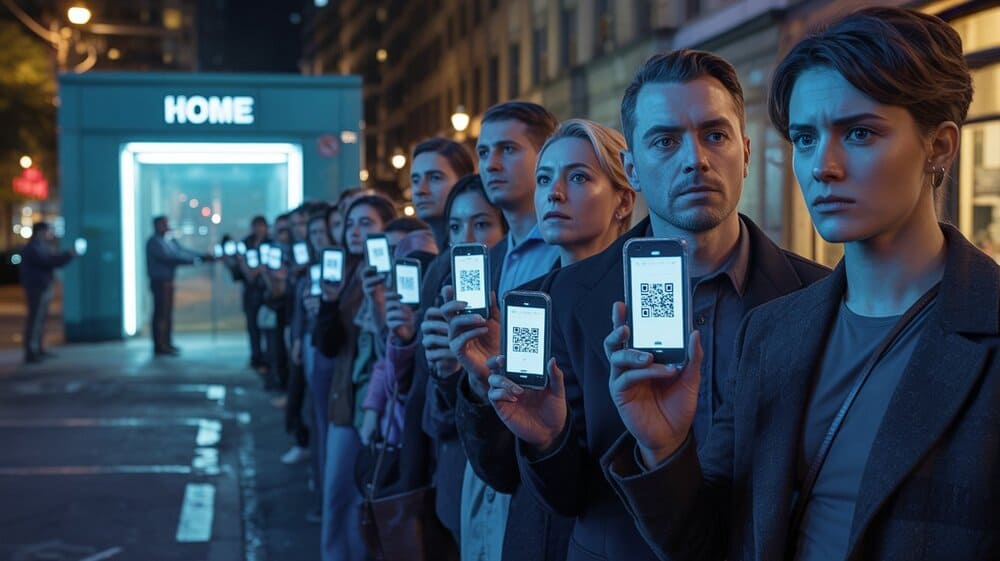
The Digital Prison We’re Building And About to Live In
Without ever casting a vote, we are watching a new world being built around us, one not governed by presidents or parliaments, but by databases, biometric scanners, and artificial intelligence.
Step by step, line by line of code, the architecture of control is rising. Most people don't even see it happening. They call it “progress.” They call it “safety.” But it's neither. It's a new kind of tyranny: a totalitarian technocracy.
What It Really Is
A totalitarian technocracy is the marriage of absolute political control with the cold efficiency of technology.
“Totalitarian” means total power over thought, speech, movement, and money.
“Technocracy” means rule by technical experts and algorithms.
Combine the two and you have a system where humans are managed like inventory. Your freedom isn't taken by force; it's erased by code.
It arrives quietly, hidden inside convenience. One more app. One more digital ID. One more scan “for your protection.” Until one day you realize you've built your own cage and the door locks from the outside.
Who's Behind It
No single villain sits on a throne pulling the levers. What we're facing is worse: a partnership between governments, corporations, and unelected global institutions.
Governments crave control and predictability. Tech giants crave data and profit.
Banks crave traceable, programmable money. And global bodies like the World Economic Forum, the IMF, the World Bank promise coordination, standardization, and safety.
Every actor has its own incentive. Together, they are constructing the digital nervous system of a world where obedience is automated.
The Tools of Control
- Digital Identity Systems tie every citizen's body to a database.
- Central Bank Digital Currencies give states the power to turn money on or off at will.
- AI Surveillance watches not just what you do but how you feel.
- Censorship Algorithms decide what you are allowed to read or say.
- Biometric Borders and Health Passports make movement conditional on compliance.
Each piece is marketed as convenience. But convenience is how control seduces free people.
Built on Your Dollar, Powered by Your Energy
Here's the ultimate betrayal: we're paying for it.
Through taxes, citizens in the U.S., the U.K., and across the developed world are funding the very systems that will one day control them. Governments hand billions in contracts to corporations like Palantir, Amazon, Microsoft, and Thales, the architects of the surveillance grid.
The public pays to build it. The corporations profit from it. And once it's running, you'll pay again through higher bills, stricter regulations, and the loss of privacy you can never buy back.
Behind it all lie vast, hungry data centers consuming staggering amounts of power and water. The International Energy Agency warns that global data-center electricity demand could double by 2026. And who covers those costs? You do, through rising energy prices, carbon taxes, and “sustainability fees.”
We are literally building the walls of the prison cells we will live in, financing the construction, paying for the power, and surrendering the keys to the system we built.
The digital state may claim efficiency, but the real price is paid by the people themselves: first through taxes, then through electricity bills, and finally through lost autonomy.

The Architects of Control
The rise of this new technocratic order is not random. It is being constructed by a small network of corporations whose systems already manage the world's borders, hospitals, tax records, and police files.
- Palantir Technologies integrates intelligence and health data for the U.S. and U.K. governments, creating real-time dashboards of entire populations.
- Oracle is rapidly buying smaller data-management and health-analytics firms, positioning itself as the infrastructure for digital identity and medical tracking.
- Amazon Web Services and Microsoft Azure run the clouds that store police footage, social-service files, and immigration databases.
- Thales and IDEMIA design the biometric passports and border-control gates that form the hardware of the European Union's new Entry/Exit System.
Each corporation claims to protect security and efficiency. Yet the underlying technology — facial recognition, motion tracking, predictive analytics — originated in military and counter-terrorism programs. Tools refined for identifying threats in conflict zones are now being normalized inside civilian life.
Warfare has always served as the proving ground for surveillance. Systems developed to monitor and manage contested populations abroad are increasingly marketed to “smart cities,” police departments, and health ministries at home. The same software that controls a border checkpoint can easily be repurposed to control a school entrance or a protest route.
The transformation is subtle but profound: the tactics of occupation have become the techniques of administration. The walls are no longer concrete; they are built from data. The watchtowers are algorithms. And the people providing the funding and the data are the very citizens who will one day live inside this digital perimeter.
The EU's Digital Gate
Europe's new Entry/Exit System is one of the clearest examples of how fast this is moving. Travelers from outside the EU are now fingerprinted and facially scanned at the border.
They call it efficiency. But what it really builds is a massive biometric database that tracks hundreds of millions of people, their movements, patterns, and associations.
And it doesn't stop there. The system connects directly to the coming EU Digital Identity Wallet. Once that wallet becomes required for travel, shopping, banking, and healthcare, freedom will no longer mean the right to act, it will mean the permission to act.
This is how fast it happens. One regulation, one software update, and the world you knew is gone.

The Doors Are Closing
The truth most people refuse to face is this: the doors are closing.
The infrastructure for digital control is already in place. It doesn't need to be built someday. It only needs to be activated.
A few legal changes, a global “emergency,” or an AI-managed currency rollout and your life could be logged, scored, and restricted before you realize what happened.
Freedom rarely disappears overnight. It fades in phases until the last door shuts, and no one remembers when the light went out.
The Illusion of Benevolence
Some defend the technocratic model. They say it will make society fairer, safer, more efficient. They claim it will prevent crime and corruption.
They are wrong. Centralized power doesn't prevent abuse, it guarantees it. Even if the engineers mean well, algorithms can't feel empathy. They can't recognize truth. They simply enforce whatever rules their masters write into them.
And once those rules serve control instead of freedom, there's no way back.

How We Fight Back
The solution isn't blind rejection of technology, it's reclaiming control over it.
Use cash. Question every new “digital identity” and “smart” solution. Choose platforms that don't harvest your data. Support independent journalism and open-source technology.
Most importantly, talk to each other. Real human connection is the one thing the system cannot digitize or control. The more we depend on one another, the less we depend on it.
Freedom isn't a setting in an app. It's a habit, a mindset, and a choice we must keep making.
If We Stay Silent
Imagine a world where every purchase, every comment, every trip, and every conversation is recorded. A world where money expires if you save too much. Where your carbon score decides whether you can travel. Where dissent is not punished by prison but by invisibility.
This is not science fiction. The infrastructure is ready. All it needs is compliance, yours.
If we do nothing, freedom will not end with a bang. It will end with the quiet click of a biometric gate closing behind you.

The Choice Before Us
Technology is a tool, not a god. It can serve life or it can serve power. The difference lies in whether we wake up in time to defend what makes us human.
The people of every free nation must now decide: do we want a world of human freedom, or one of digital obedience?
The doors are closing, but not yet locked. We can still step back, if we act, speak, and refuse to comply with systems that see us as data, not as souls.
The future has not been written by machines. It's written by those who dare to remain human.
About the Author
Scott Oliver is a British writer and former Royal Marines Commando who has lived abroad since 1985. Over the last 66 years, he’s called twelve countries home, including twenty-five years in Spanish-speaking nations such as Spain, Costa Rica, and Guatemala. He has also lived in Sierra Leone, Ghana, Nigeria, Liberia, Cyprus, the USA, Grand Cayman and now lives in Mauritius.
A warrior by nature, Scott is living with prostate cancer and writing from the front lines. He speaks directly to men about health, masculinity, freedom, and strength, physically, mentally, emotionally, and sexually. His views are proudly independent: he questions conventional medicine, challenges destructive treatments, and tells the truth most men never hear.
Scott Oliver is an officially accredited member of the National Writers Union (NWU) and the International Federation of Journalists (IFJ), the world’s largest organization of professional journalists. He spent ten years on Wall Street and another decade as an offshore wealth manager, specializing in globally diversified, multi-currency hedge fund portfolios. He is the author of What If Cancer’s Best Defense Is Free? — Sleep as a Defense Against Cancer: A Former Royal Marines Commando’s 4,000-Hour Research Roadmap, where he reveals how sleep repairs DNA, restores immunity, and strengthens your fight against cancer. He’s also the author of books on offshore investing and Costa Rica real estate and has written thousands of articles in English and Spanish on living abroad with courage, clarity, and conviction.
You can always contact Scott Oliver here with your questions and suggestions.
Expert Resources Used By Scott Oliver To Research and Write This Article:
- “Energy Demand from AI” — International Energy Agency
A detailed report projecting how AI and data-center growth will drive global electricity usage higher through 2030. iea.org - “Data Centre Energy Use: Critical Review of Models and Results” — IEA-4E / EDNA
An analysis of how models estimate energy consumption in data centers, their assumptions, and pitfalls. iea-4e.org - “The Surveillance AI Pipeline” — Kalluri et al. (arXiv)
A scholarly paper tracing how computer vision research flows into surveillance applications over decades. arXiv - “AI, Climate, and Regulation: From Data Centers to the AI Act” — Ebert et al. (arXiv)
An academic work linking AI infrastructure, energy use, and regulatory needs. arXiv - “What Is Palantir? The Company Behind Government AI Tools” — Built In
A technology profile explaining how Palantir's software is used by police, military, and government agencies. builtin.com - “ICE to Use ImmigrationOS by Palantir … to Track Immigrants” — American Immigration Council
An article on how Palantir's systems integrate multiple government databases to build individual profiles. americanimmigrationcouncil.org - “Palantir granted $30 million to build ‘ImmigrationOS' surveillance platform” — Immigration Policy Tracking
Coverage of the $30 million U.S. government contract for Palantir's ImmigrationOS project. immpolicytracking.org - “Palantir's tools pose an invisible danger we are just beginning to …” — The Guardian
An opinion piece assessing civil-liberties risks in Palantir's technology deployment. theguardian.com - “Data held by the EES – ETIAS – Europa.eu” — European Commission
Official page describing what biometric and travel data the EU Entry/Exit System collects and retains. europa.eu - “Executive summary – Energy and AI – Analysis” — International Energy Agency
The summary of the IEA's major findings on how data-center energy demand will scale. iea.org